


LAYOUT MENU

Corporate crime persists in the shadows
Unlike violent crimes, there are no comprehensive national statistics on the serious misconduct of companies. Some see a need for change.
Support sound science and smart stories
Help us make scientific knowledge accessible to all
Donate today
Mary Gay Scanlon cut her teeth in Congress scrutinizing Big Tech’s enormous power over Americans’ lives. As she and fellow representatives on the Judiciary Committee set about their 16-month investigation, she was itching to explore corporate misconduct across a wider swath of industries.
“It seemed like an area that was ripe to address,” Scanlon, a Democratic representative from Pennsylvania, says. “But there was no data.”
Corporate misconduct can have vast consequences, from contaminating groundwater to wiping out retirement savings to fueling an opioid crisis. But there’s a stark contrast between the information on these crimes compared to that on individual crimes such as theft and assault.
“The FBI, who is the predominant supplier of crime data in the United States, does not capture corporate crime data like price fixing, tax evasion, cooking the books — those kinds of things,” says Alexis Piquero, a former head of the Bureau of Justice Statistics, part of the US Department of Justice. Federal records of corporate misconduct do exist, but they tend to be spread across myriad federal agencies, each focused on its own narrow section of the law.
As a result, it’s difficult to determine even the most fundamental questions about corporate crime. How many victims are there? How much does it cost consumers? What kind of companies are most likely to commit crimes, and when? How effective are government interventions and corporations’ own efforts at compliance?
The answers, it seems, are buried in agency basements and muddled by idiosyncratic record-keeping.
“If you were to ask me, ‘Alex, how many price-fixing arrests were made this year?’ The answer would be, ‘I don’t know, and no one else knows either,’” Piquero laments. “And that’s an embarrassment that in 2025 we don’t have the answer to that question.”
A need to share data
That’s not to say the information doesn’t exist. Each federal agency keeps its own records about the corporate crime cases it has opened, the companies involved, the alleged misconduct and the outcome of those cases. But data mostly remain siloed within that agency — not pooled with information from other departments, says Sally Simpson, a criminologist at the University of Maryland, College Park.
“In the United States, there is no centralized data repository that captures the full extent of the phenomenon, by company, across offense types and legal venues (criminal, civil and regulatory),” Simpson writes in the 2025 Annual Review of Criminology, “nor are there systematic data collected from victims or self-reported offenders that can cross-validate official counts.”
On top of that, federal agencies decide for themselves exactly what information they’ll capture and how they will format it. They make different choices, complicating attempts at comprehensive research.
“They all use different criteria for when a case is brought and what kind of information is collected about the case,” says Simpson. “So creating what’s called a crosswalk between all of these different sources of data, so that you’re collecting similar data, becomes quite complex.”
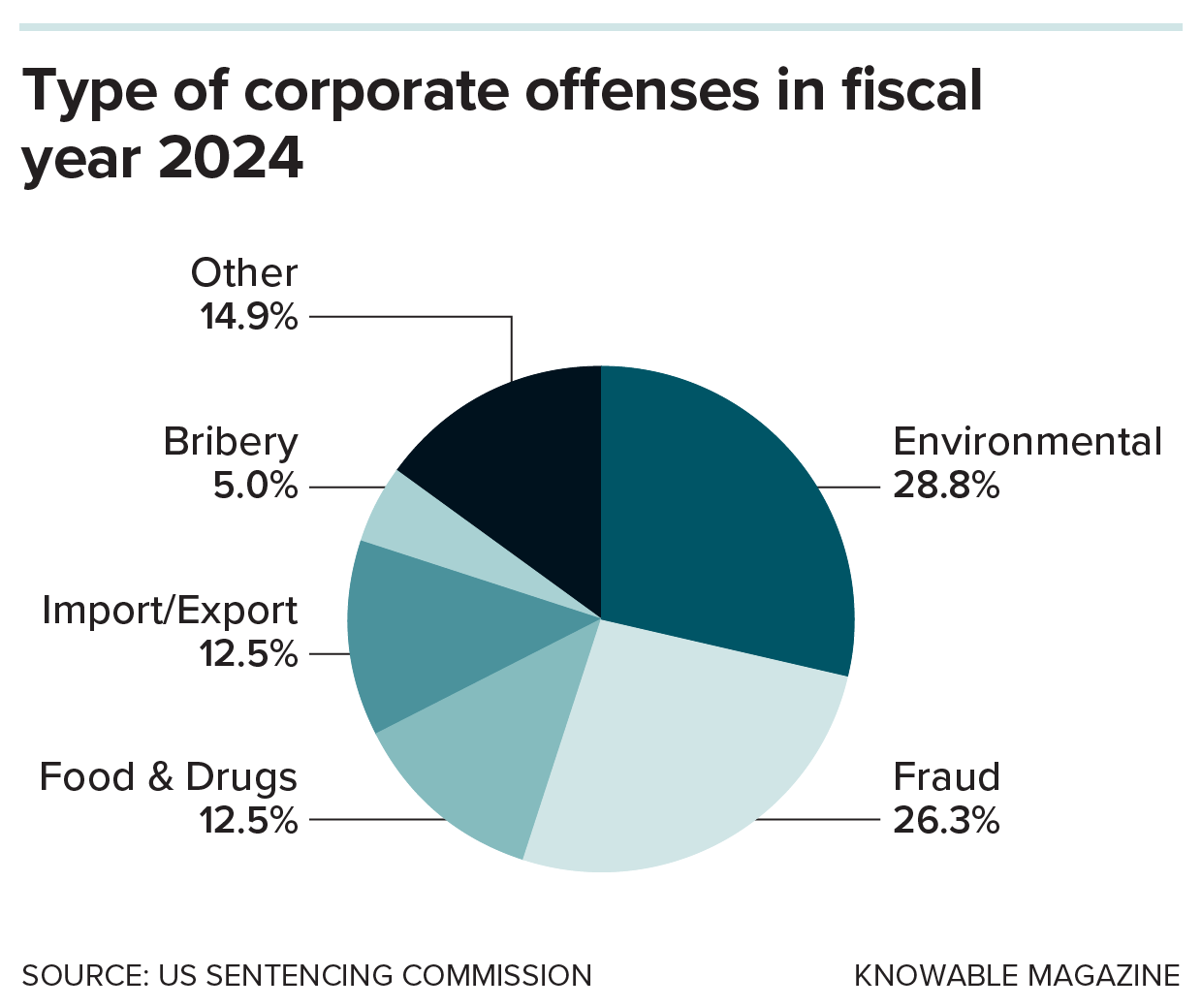
Corporate crime can include numerous kinds of offenses, with wide-ranging consequences. In fiscal year 2024, the US Department of Justice sentenced corporations for 80 crimes that included environmental, fraud, and food-and-drug-related offenses. But the full extent of such misconduct is difficult to track.
Peter Yeager encountered all of this firsthand as a graduate student at the University of Wisconsin–Madison in the 1970s. At the time, he was studying violations of federal law by the 582 largest American corporations. It was not easy. He and his fellow academics had to go to 24 different federal agencies to capture the full spectrum of potential violations.
It was the 1970s, so “we did it with computer cards — 80-column computer cards,” he recalls. “Our output was not on a computer; it was all on paper, and it reached about 10 feet high.”
Yeager ultimately published a comprehensive examination of white collar crime in the US. That was in 1979. Lawmakers have described it as “the last comprehensive DOJ report on corporate crime” — which stirs up mixed feelings in Yeager. “I was pleased to read that,” he says. “But also a little distressed, that that’s the fact still.”
Street crimes yield better data
Today, street crimes and violent crimes such as murders, thefts and assaults, are as pervasive in conversation as ever — discussed constantly at all levels of politics and in the news. Violent crime is frequently rated as important by voters and is a major driver of electoral politics.
“We have a two-tier system of justice. If it’s corporate crime, then you get a slap on the wrist, you pay a fine, and you go on to commit it again, often — versus individuals going to jail for long stretches.”
— MARY GAY SCANLON
And this side of the criminal justice system is carefully studied and documented. The Bureau of Justice Statistics, for example, publishes annual data on violent incidents, broken down by the ages of offenders and victims; on inmate deaths in federal custody; on capital punishment and much more. Crucially, it even conducts a yearly “criminal victimization” survey, in which the government interviews roughly 240,000 citizens about their experiences in the past year with such crimes as robbery, assault and break-ins — regardless of whether respondents reported those incidents to the police.
This effort helps shed light on the “dark figure” or “hidden figure” of crime, meaning offenses that have been committed but haven’t been discovered or reported, so they don’t show up in official statistics. It helps to paint a more complete picture of what’s actually happening on the ground, not just what shows up in court.
But the bureau’s criminal victimization survey does not ask people if, for example, they have been cheated out of wages or lied to by an investment advisor. The “hidden figure” of corporate crime is still very much hidden, says Simpson. The United States doesn’t have systematic data from victims or even from self-reported offenders to help researchers triangulate with the official records.
These disparities rob researchers, policymakers and the public of basic information about the extent of corporate misconduct and how it affects their lives. “We’ve got a whole ream of hypotheses 50 years old,” Yeager says. For example, his 1979 deep dive into major US corporations showed that the large companies of the day were more likely to offend when their sales, profits, earnings and product diversification were trending downward.
The data gaps also make it difficult to determine the effectiveness of the government’s responses. Corporate prosecutions have been trending downward since the early 2000s, and the Department of Justice has come to lean more heavily on non-prosecution agreements and deferred prosecution agreements. In these, companies agree to make changes to their operations and frequently end up paying a fine in order to avoid court. Globally, corporations have been spending billions on internal compliance efforts to prevent legal and regulatory violations. Still, there’s little definitive scholarly research on how well these arrangements work in deterring corporate crime and what the most effective approaches to deterring and policing it may be, says Simpson.
“There are all of these things companies try to do, but we don’t know how successful they are, because we have very few empirical studies,” she says.
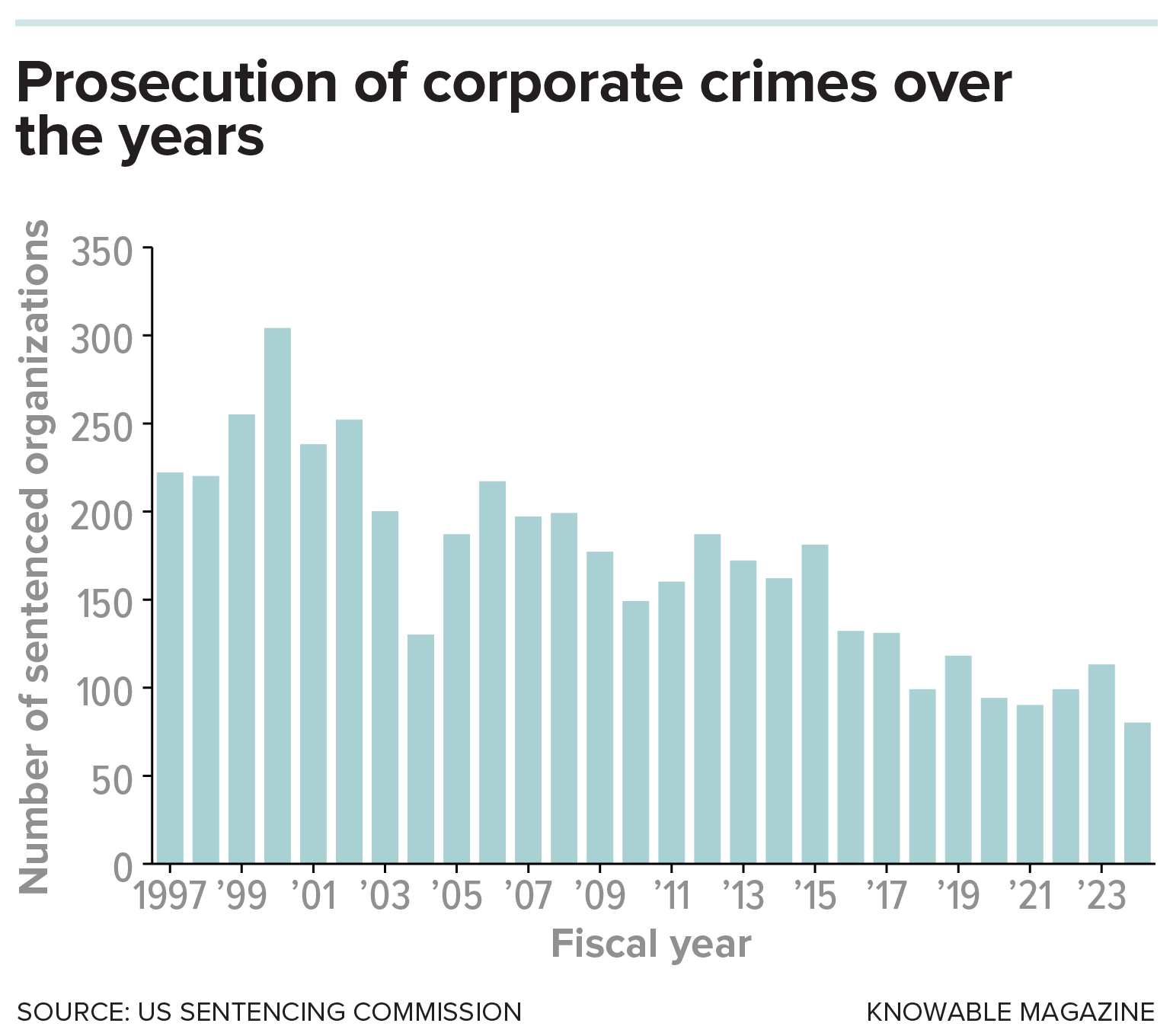
Federal prosecutions of corporations have dropped over the years. And the data shown in this chart do not shed light on corporate crimes that were not investigated, or that the US Department of Justice did not bring to court.
Scanlon finds these disparities troubling. “We have a two-tier system of justice,” she says. “If it’s corporate crime, then you get a slap on the wrist, you pay a fine, and you go on to commit it again, often — versus individuals going to jail for long stretches, ending up with mass incarceration.”
Registry of company misdeeds
Some progress has been made to bring corporate misconduct data into public view. The Consumer Financial Protection Bureau launched an initiative in June 2024 to create a public registry of nonbank financial companies that have broken consumer protection laws. At the time, the bureau’s leadership touted the registry as a way to help consumers determine whether a company is trustworthy, and to help the bureau determine which companies are repeatedly violating the law. Bureau representatives did not reply to requests for comment about the program’s status under the Trump administration.
Also, under the Biden administration, the Department of Justice created a website chronicling the latest corporate case resolutions across many offense types, from antitrust to money laundering. But the data start only in 2023, so anyone hoping to look further back would be out of luck. On top of that, the data capture only concluded court cases, thereby missing out on enforcement actions that don’t go through federal courts — such as violations that are pursued only by regulatory agencies.
And while some non-government organizations, such as nonprofits and universities, have made headway in compiling databases for public use, they aren’t part of the official record. Yeager believes the surest way to secure resources for a centralized, government database lies with Congress.

To that end, Scanlon reintroduced the Corporate Crime Database Act in July of 2025. The bill calls for agencies to submit information about their enforcement actions to the Bureau of Justice Statistics, which would then aggregate and analyze the information and publish a database for public use. Previous iterations of the bill have been introduced in eight different years, so far without success.
Industry lobbyists are part of the holdup, in Scanlon’s view. Or, as she puts it, “people who are making money off not being held accountable.” And the Trump administration has backed off from some areas of white-collar policing. But nonpartisan factors are also likely at play: Piquero says he encountered good old-fashioned institutional inertia during his time in the Bureau of Justice Statistics when he attempted to spearhead an initiative to centralize corporate crime data. “There’s this rigidity of ‘this is the way we’ve always done things,’” he says.
From a technical point of view, collecting better data is eminently achievable, Piquero notes. “There’s no reason why it can’t be done. It’s just a matter of people getting together at the table and saying, ‘OK, this is what we’re going to do.’”
10.1146/knowable-020326-1
TAKE A DEEPER DIVE | Explore Related Scholarly Articles
More From