



Close to the eastern tip of Canada, in Nova Scotia’s picturesque Halifax harbor, a local firm has joined the fight against climate change. There, Planetary Technologies has figured out how to turn the cooling water of a power plant into a tool against global warming, by enhancing its capacity to absorb carbon dioxide from the air.
Founded in 2019, Planetary Technologies is at the vanguard of an emerging worldwide effort to squirrel away industrial carbon emissions in the ocean. It’s still early days — most firms have only proof-of-concept or pilot plants, and there are sizable hurdles to clear before they will be able to slash emissions on any meaningful scale — but many climate experts see ocean carbon storage as a promising decarbonization tool.
The world’s window for limiting global warming beyond catastrophic levels is fast closing. Experts increasingly agree that to prevent runaway climate change and to reach net-zero emissions of CO2 into the atmosphere, we need to look beyond phasing out fossil fuels: We also need to remove carbon that’s already been emitted.
“There’s no net-zero without carbon dioxide removal,” says Andrew Lenton, director of CarbonLock, a CO2 removal research program at CSIRO, Australia’s national science agency.
So far, removal efforts have largely been confined to land — from planting trees to building facilities that capture CO2 directly from air. But many of these approaches come with a big drawback: competition for land and other resources. “That’s one reason why people have looked to the possibility of the ocean,” says Scott Doney, a biogeochemist at the University of Virginia who coauthored a 2025 article on marine carbon dioxide removal methods in the Annual Review of Marine Science.
The ocean is already one of humanity’s biggest climate allies: It has absorbed more than 90 percent of excess heat generated by global warming. It is a gargantuan carbon sink, storing a third of all carbon emitted by humans since the Industrial Revolution and, overall, 42 times more carbon than the atmosphere does. “Why not mimic what we already know is a winner under natural circumstances?” says Planetary Technologies’ cofounder Greg Rau, a marine biogeochemist at the University of California, Santa Cruz.
Ocean sponge
Harnessing the immense potential of the ocean to sequester CO2 — a field known as marine carbon dioxide removal — can be done in various ways (see sidebar). These efforts aim to enhance naturally occurring biological or chemical processes that convert carbon into stable inorganic forms, locking it away in seawater for hundreds to thousands of years. If one thinks of the ocean as a giant sponge soaking up CO2 from the air, then ocean carbon storage aims to improve its absorbency or to increase the size of the sponge.
One promising way to do this is called ocean alkalinity enhancement. Planetary Technologies pursues one form of this. “If we can find a way to raise the alkalinity, then that actually increases the capacity of the ocean to absorb carbon dioxide,” explains marine biogeochemist Patrick Martin at Singapore’s Nanyang Technological University, who is not affiliated with Planetary Technologies.
With an average pH of 8.04, the surface ocean is already alkaline, thanks to a natural process called rock weathering. This occurs when atmospheric CO2 dissolves in rainwater and reacts with alkaline rocks on land to form carbonate and bicarbonate ions, which then get washed out to the ocean. This process acts as our planet’s natural thermostat, and is what has kept carbon dioxide — and global temperatures — in check for most of Earth’s history.
Unfortunately, rock weathering has struggled to keep pace with human carbon emissions — it unfolds over tens of thousands of years, too slowly to correct our rapidly warming planet. Ocean alkalinity enhancement aims to accelerate this process by raising alkalinity in other ways.
For example, Planetary Technologies, in partnership with Nova Scotia’s Dalhousie University, adds a chalky slurry of magnesium hydroxide to a power plant’s water outflow before that water is discharged into the harbor. This slurry, says Rau, dissolves slowly in seawater, thus preventing sudden spikes in pH. “It’s like a time-release effect,” he says.
The magnesium hydroxide makes seawater more alkaline, which causes dissolved CO2 to convert to stable bicarbonate and carbonate ions that can remain sequestered in seawater for up to a hundred thousand years. Converting this dissolved CO2 shifts the chemical equilibrium of the seawater, and to restore balance, the ocean absorbs more CO2 from the atmosphere.
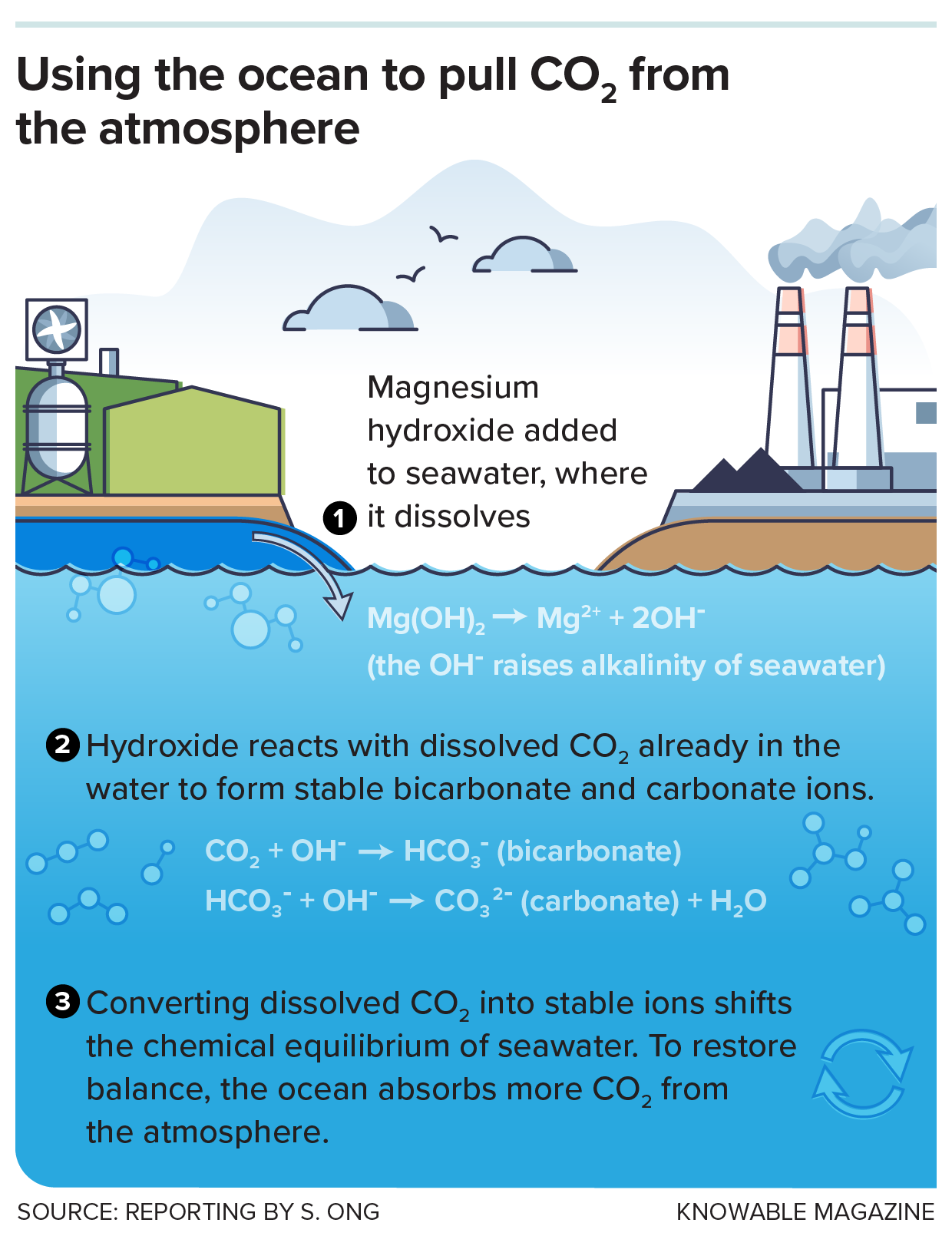
At Planetary Technologies’ facility in Halifax, Canada, magnesium hydroxide is added to seawater, increasing its alkalinity. This ultimately draws carbon dioxide from the air and stores it in the ocean as carbonate and bicarbonate ions.
Since commencing operations in September 2023, Planetary Technologies’ Nova Scotia facility has removed more than 3,600 metric tons of CO2, making it one of the leaders in ocean carbon storage. In June 2025, the firm delivered the world’s first independently verified ocean alkalinity enhancement carbon credits — allowances tied to emission reduction projects that companies or individuals can purchase to offset their emissions — to customers Stripe, Shopify and British Airways. Two months later, it signed a $31.3 million deal with Frontier, a carbon credit purchasing coalition whose backers include Meta and Google, to deliver 115,211 metric tons of carbon removal credits over the next four years.
A different route to enhancing alkalinity is being pursued by the Italian startup Limenet at its facility on Sicily’s eastern coast. Lime derived from a local quarry is mixed with seawater and CO2 from a nearby biogas plant, forming an aqueous solution of calcium bicarbonate. This is then returned to the ocean, where it is stored as bicarbonate ions.
Other companies are also developing projects to enhance ocean alkalinity, including Vycarb, Vesta and CREW Carbon in the United States, as well as Capture6 in Australia.
Raising alkalinity may, at a local scale, tackle another ill effect of fossil fuel emissions — ocean acidification. Thanks to industrial carbon emissions, the average pH of surface seawater has fallen from 8.2 to 8.04 globally, corresponding to a 30 percent spike in acidity.
This is especially harmful for marine organisms — including corals, crustaceans, mollusks and some plankton — that construct exoskeletons and shells of calcium carbonate. When pH falls, carbonate ions become less available, leading to negative impacts on marine food webs and fisheries, says David Kwabi, an environmental engineer at Yale University. Enhancing ocean alkalinity can mitigate this effect locally, though the benefit is unlikely to be global. “In principle, the health of marine life could benefit,” Kwabi says.
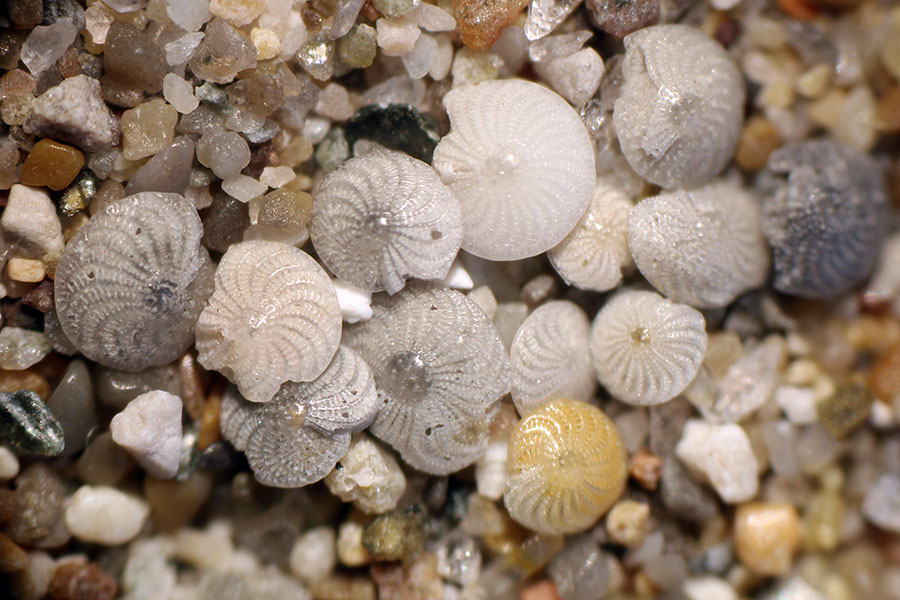
As more carbon dioxide enters the atmosphere, it makes seawater more acidic. This threatens the ability of marine creatures, like these tiny single-celled organisms called foraminifera, to make shells from calcium carbonate. Efforts to make the ocean more alkaline could provide local relief from the effects of acidification on these organisms.
CREDIT: HOLGER KRISP / WIKIMEDIA COMMONS
An uphill climb
But for all the potential of ocean carbon storage, significant hurdles remain before these technologies can be released into the real world on any meaningful scale. For a start, scientists need to study how manipulating ocean chemistry will affect marine organisms and ecosystems. Adding a lot of alkaline material in a small spot could change ocean chemistry too rapidly and stress marine life if not done carefully, says Doney.
“The devil is always in the details,” adds Martin. “It always comes down to exactly what concentrations are we dealing with? How quickly is that being diluted?”
For now, little if any real-world data exist on how raising ocean pH will affect sea life (Planetary Technologies and other firms stress that they closely monitor marine health during testing). “We haven’t done so many biological experiments yet, on a broad enough range of species, to be really confident yet in the answers,” Martin says.
Marine CO2 removal also raises thorny issues of international governance, given that changes to ocean water are likely to extend beyond national boundaries. “Governance is relatively easy when you do this type of manipulation on land, because it involves one country,” says oceanographer Jean-Pierre Gattuso at Sorbonne University in Paris. “But currently, there is no regulation for the open seas.”
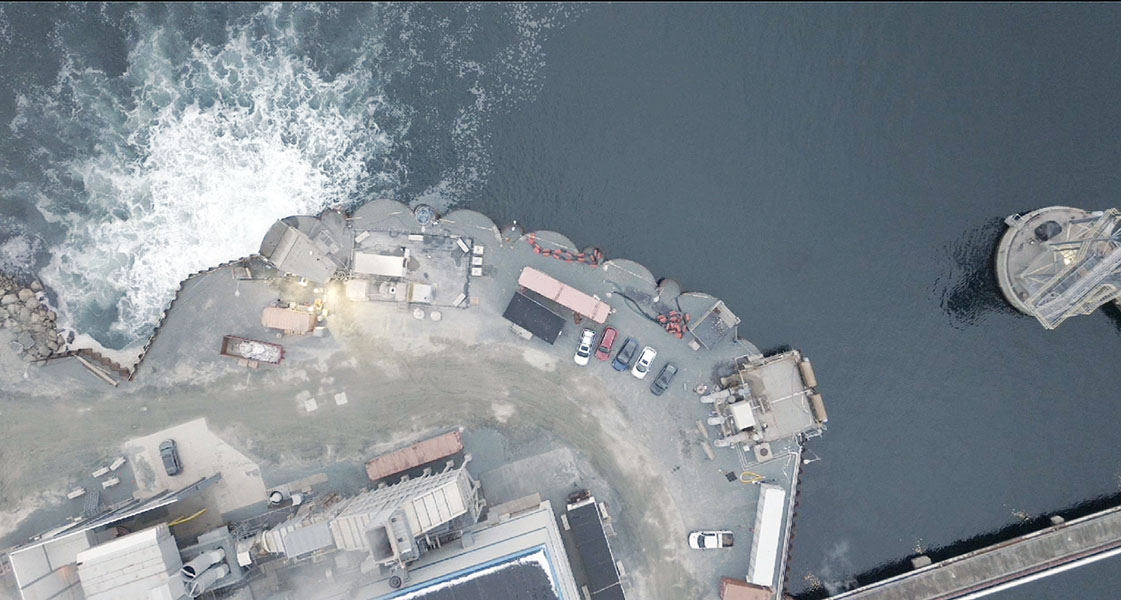
Planetary Technologies’ facility (the small buildings next to the turbulent water) adds magnesium hydroxide to cooling water discharged by a power plant along Halifax harbor. The facility removes an estimated 10,000 metric tons of carbon dioxide from the atmosphere each year.
CREDIT: PLANETARY
Questions also persist over whether ocean carbon storage endeavors can truly achieve a carbon-negative footprint. A 2022 analysis that studied ocean liming — a type of ocean alkalinity enhancement that spreads processed limestone into the ocean — found that the answer is yes. To pull 1,000 kilograms of CO2 from the atmosphere, the authors calculated, required 1,321 kilograms of quicklime to be scattered into seawater. Mining, processing and spreading that lime emitted only 449 kilograms of greenhouse gas, implying an overall net carbon reduction. The benefit would be even greater if some or all of the CO2 released during processing could also be captured and stored, they noted.
Other practical issues must be solved. For ocean carbon storage to have a place in the real world — and for firms to sell credits on carbon markets — companies and governments must establish accurate and reliable systems for monitoring, reporting and verifying the amount of carbon sequestered.
Research efforts to quantify the net amount of carbon stored are “very much a work in progress,” says Martin. Tracking of sequestered carbon in the ocean is fiendishly difficult, since ocean currents and mixing result in signals being dispersed and diluted across vast distances. “It’s like mixing cream into your coffee at the surface of your cup,” says Doney. “It’s going to mix and spread out throughout your entire cup over time.”

Then there’s the issue of scale. Planetary Technologies’ facility currently removes an estimated 10,000 metric tons of carbon from the atmosphere each year — a mere drop in the bucket given that the experts estimate we need to sequester 7 to 9 gigatons of CO2 annually to meet our net-zero goals by midcentury. To make any meaningful dent in the global problem, they would need to ramp up massively, and fast. That could require a mining effort equal to or greater than that of the global cement industry; cement production reached a staggering 4.2 billion tons in 2024.
And, “you would need a million of these plants, or you’d need to scale up these plants by a factor of 1,000,” Doney says. “Obviously, we’re not going to build a million of these plants around the world.”
But, says Lenton, ocean alkalinity enhancement efforts piggyback easily on existing water infrastructure, such as wastewater treatment facilities and desalination plants, which would negate the need to build vast numbers of facilities from scratch.
And, he adds, ocean carbon storage is but one useful tool in a toolbox filled with decarbonization strategies that can, hopefully, get the world to net-zero. “No single method can do it all,” he says.