

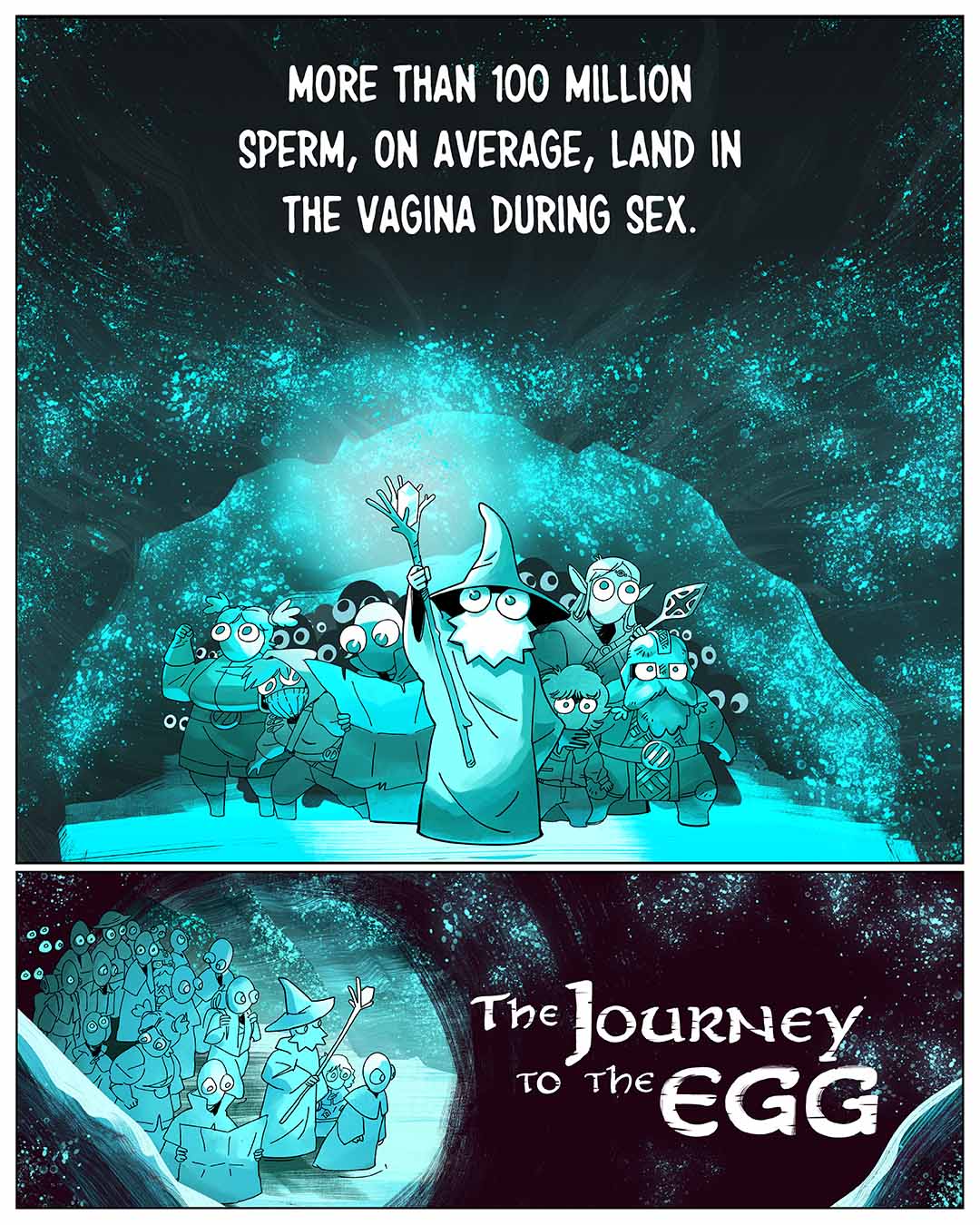







The Journey to the Egg: More than 100 million sperm, on average, land in the vagina during sex. lllustration: A group of individuals representing sperm cluster together as they peer out of a cave. They are led by a wizard in a pointy hat and robe, holding up a crystal-topped staff.
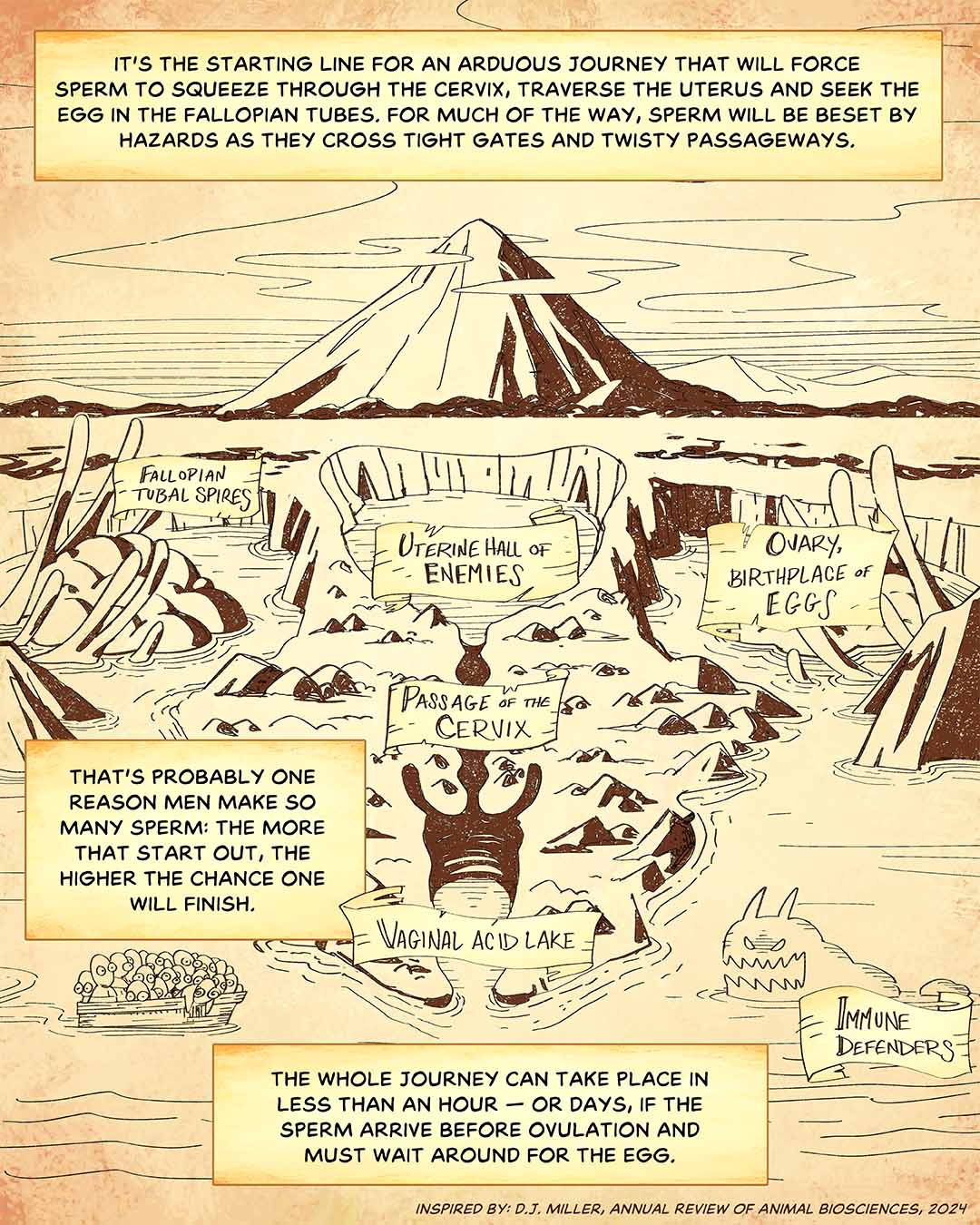
It’s the starting line for an arduous journey that will force sperm to squeeze through the cervix, traverse the uterus and seek the egg in the fallopian tubes. For much of the way, sperm will be beset by hazards as they cross tight gates and twisty passageways. That’s probably one reason men make so many sperm: The more that start out, the higher the chance one will finish. The whole journey can take place in less than an hour — or days, if the sperm arrive before ovulation and must wait around for the egg. Illustration: Map of a daunting landscape, with boatload of sperm approaching on water. Obstacles are labeled Vaginal Acid Lake; Immune Defenders; Passage of the Cervix; Uterine Hall of Enemies; Ovary, Birthplace of Eggs; Fallopian Tubal Spires.
It’s an odyssey with a purpose: the trials will select for quality sperm. Illustration: Malformed sperm try to find their way and bump into each other, some following signs that indicate “wrong,” “waiting room” and “exit.”
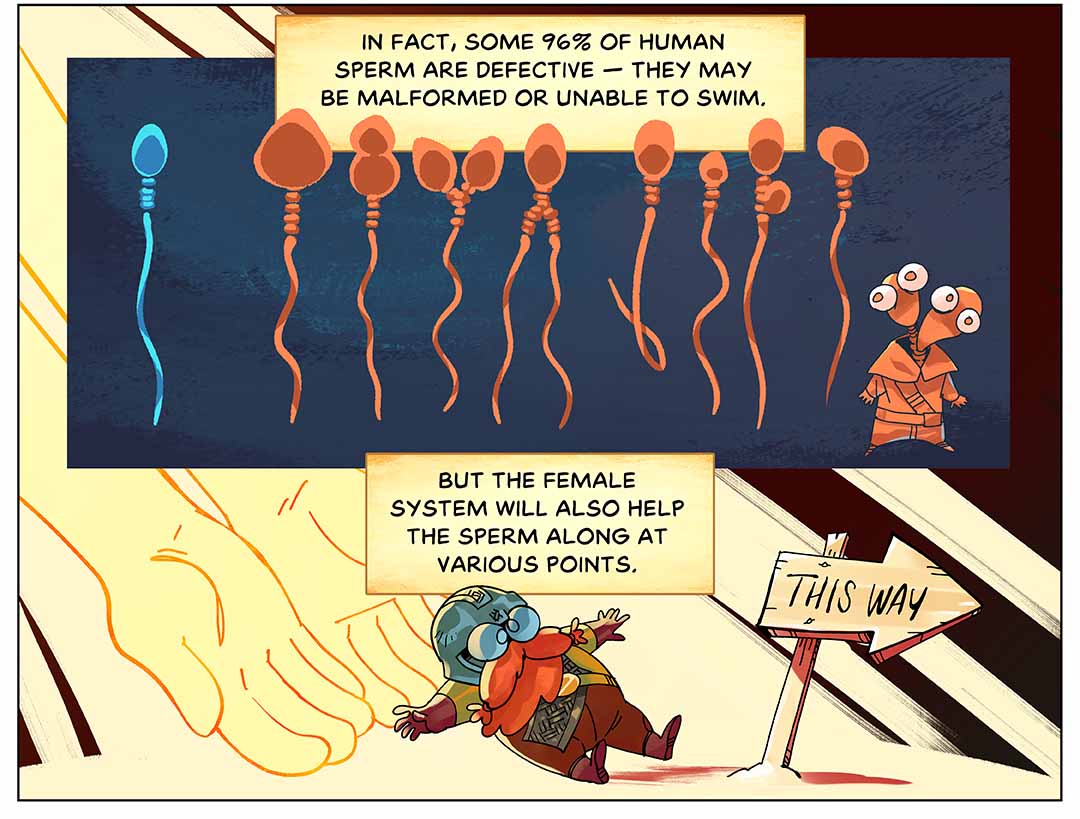
In fact, some 96% of human sperm are defective — they may be malformed or unable to swim. But the female system will also help the sperm along at various points. Illustration: An inset shows a normal sperm cell with a head, midpiece and tail, alongside several malformed ones in orange, with irregular shapes, sizes and structures, including double heads or tails. Below, helping hands usher a sperm character in the right direction toward a sign that reads “this way.”
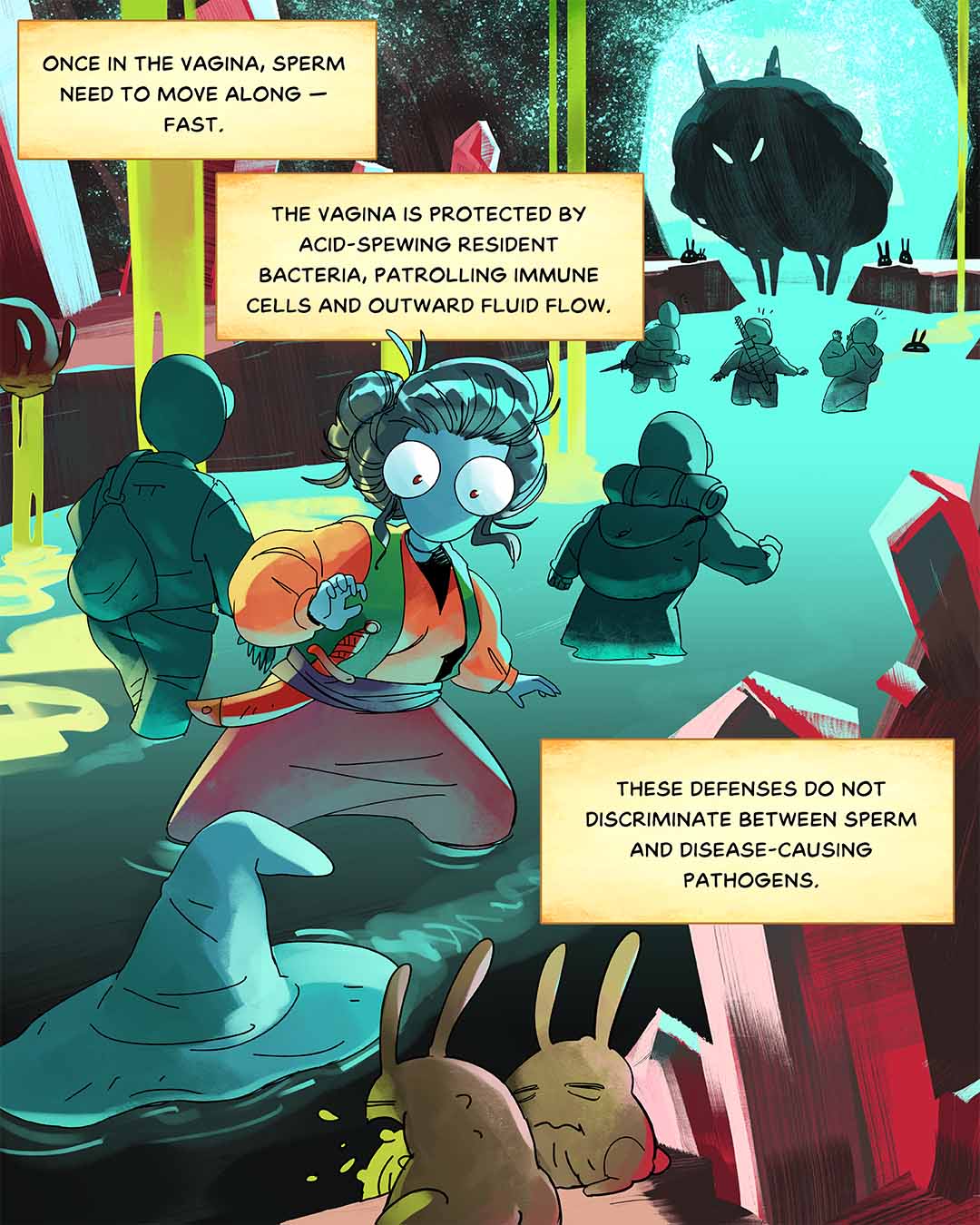
Once in the vagina, sperm need to move along — fast. The vagina is protected by acid-spewing resident bacteria, patrolling immune cells, and outward fluid flow. These defenses do not discriminate between sperm and disease-causing pathogens. Illustration: Sperm characters wade through a channel, with a looming figure ahead.
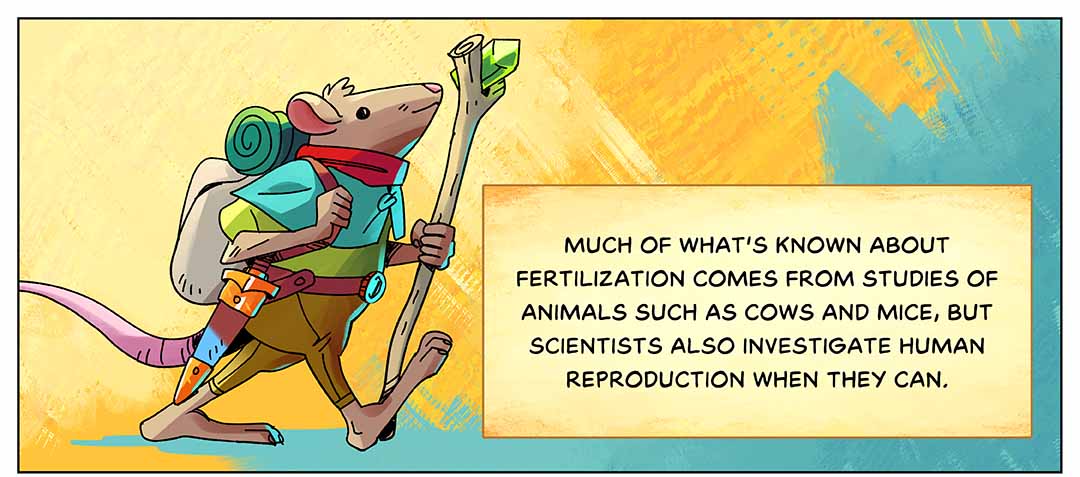
Much of what’s known about fertilization comes from studies of animals such as cows and mice, but scientists also investigate human reproduction when they can. Illustration: A mouse dressed in hiking gear, carrying a backpack and holding a walking staff topped by a crystal.
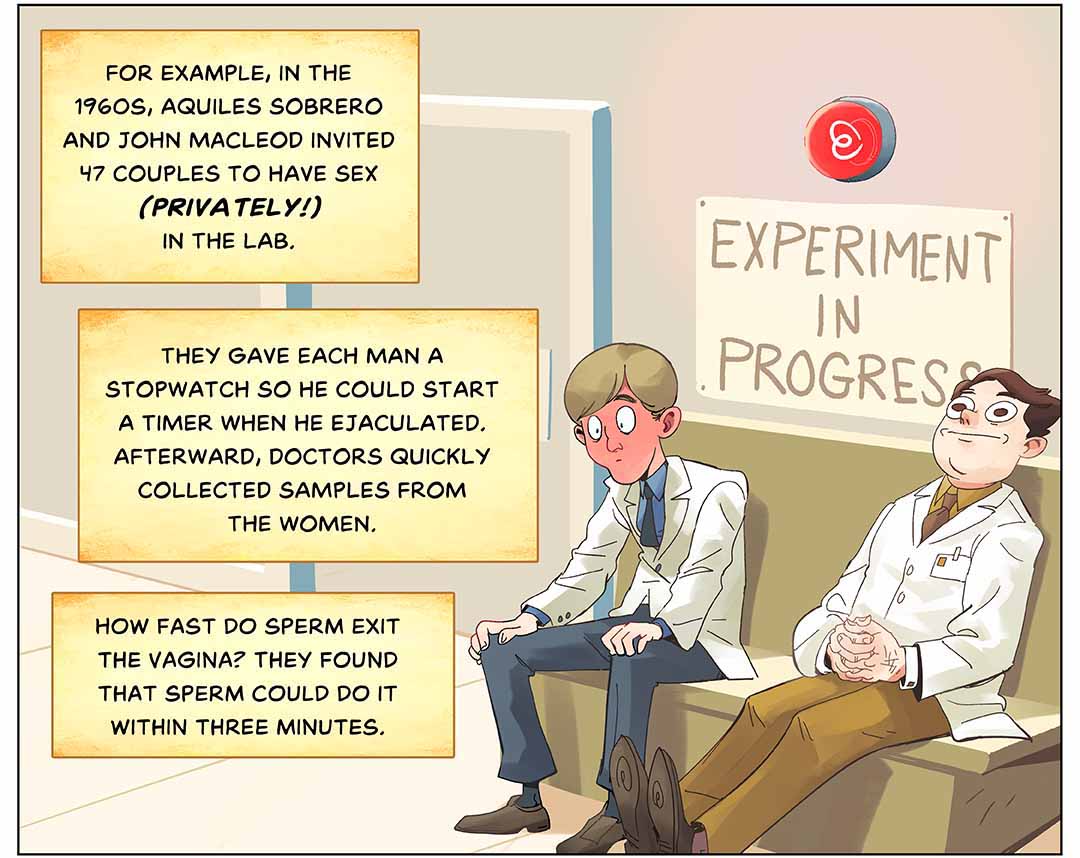
For example, in the 1960s, Aquiles Sobrero and John MacLeod invited 47 couples to have sex (privately!) in the lab. They gave each man a stopwatch so he could start a timer when he ejaculated. Afterward, doctors quickly collected samples from the women. How fast do sperm exit the vagina? They found that sperm could do it within three minutes. Illustration: Two scientists in white coats sit wait by a laboratory door, with a sign behind them that reads “Experiment in progress.”
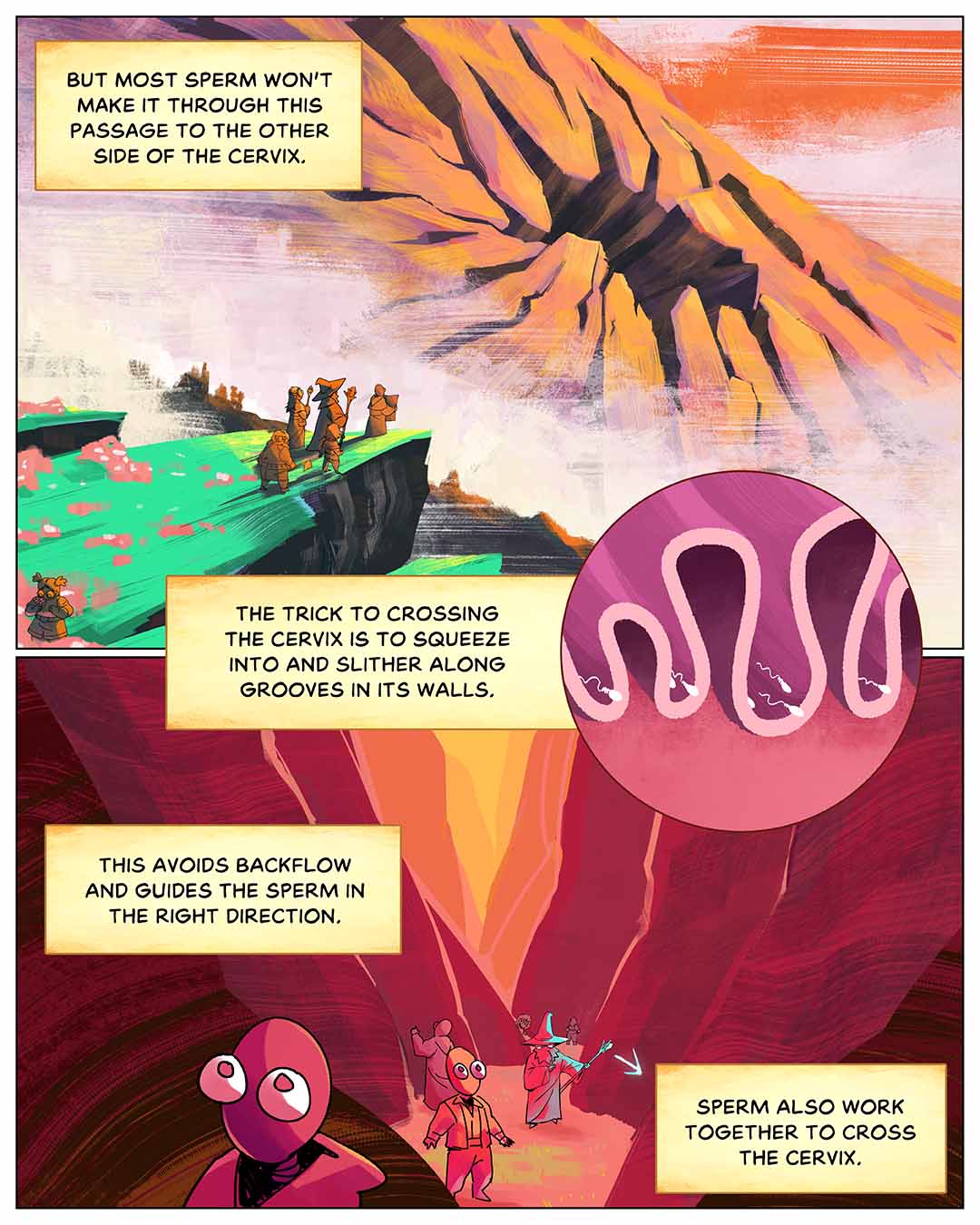
But most sperm will go no farther. The trick to crossing the cervix is to squeeze into and slither along grooves in its walls. This avoids backflow and guides the sperm in the right direction. Sperm also work together to cross the cervix. Illustration: Three views of the journey. One shows figures standing at the edge of a cliff looking toward a looming mountain with large cracks, representing cervical structures. The second is a detail view of sperm swimming through curvy structures of the cervix. The third shows figures walking through a narrow passageway with curving walls.
“That’s been a long-standing question in the field: why do you need millions, when only one fertilizes the egg? One good, and fairly recent, explanation is that they assist each other by swimming cooperatively,” says David Miller, reproductive biologist, University of Illinois. Illustration: Portrait of a man with glasses, in a suit, with a speech bubble overhead. Inset image of characters standing in a circle offering various items — a book, a spoon, a ball, a trumpet, a sandwich — as the wizard looks on.
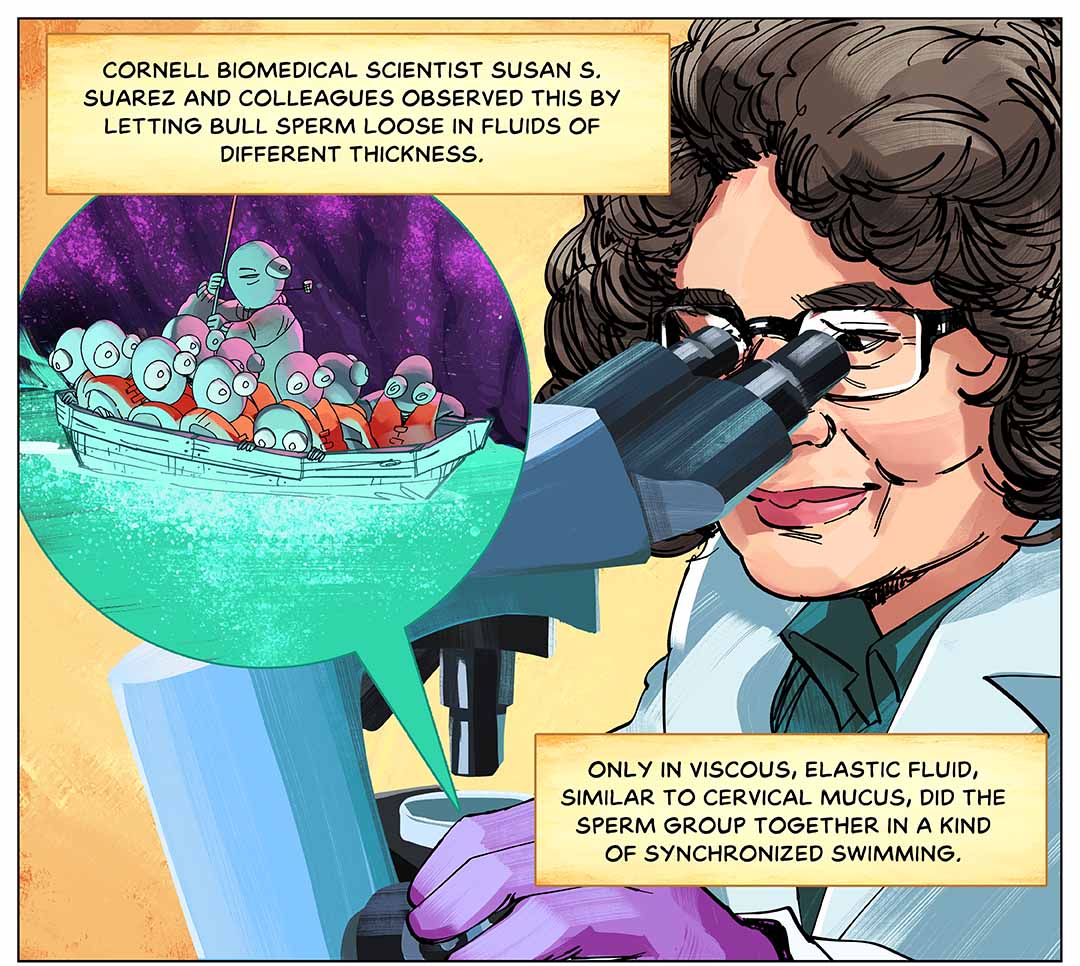
Cornell biomedical scientist Susan S. Suarez and colleagues observed this by letting bull sperm loose in fluids of different thickness. Only in viscous, elastic fluid, similar to cervical mucus, did the sperm group together in a kind of synchronized swimming. Illustration: A scientist in a white coat and glasses peers into a microscope; an inset image shows what she sees: a boatload of sperm floating along.
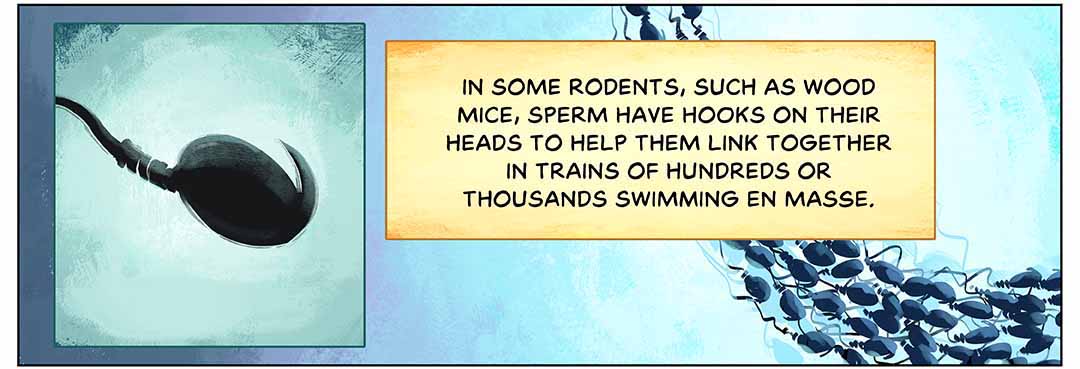
In some rodents, such as wood mice, sperm have hooks on their heads to help them link together in trains of hundreds or thousands swimming en masse. Illustration: Inset of a sperm, with a hooked structure on its head. Larger panel shows a stream of sperm swimming along.
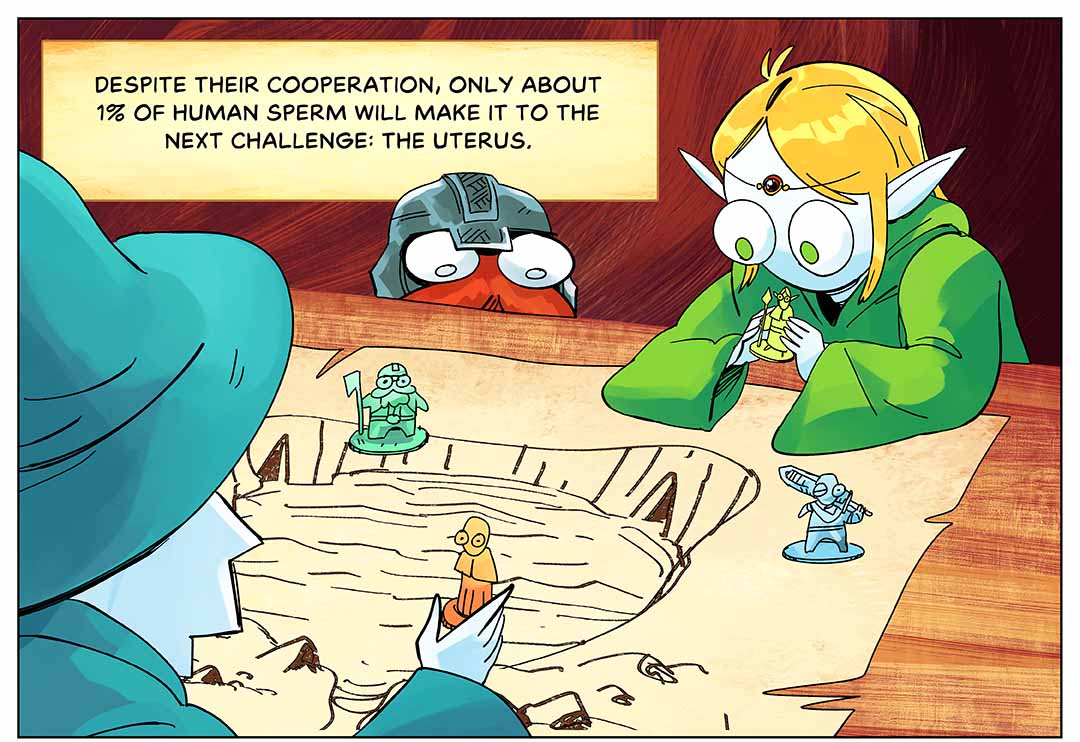
Despite their cooperation, only about 1 percent of human sperm will make it to the next challenge: the uterus. Illustration: Two wizards look over a map, holding figurines.
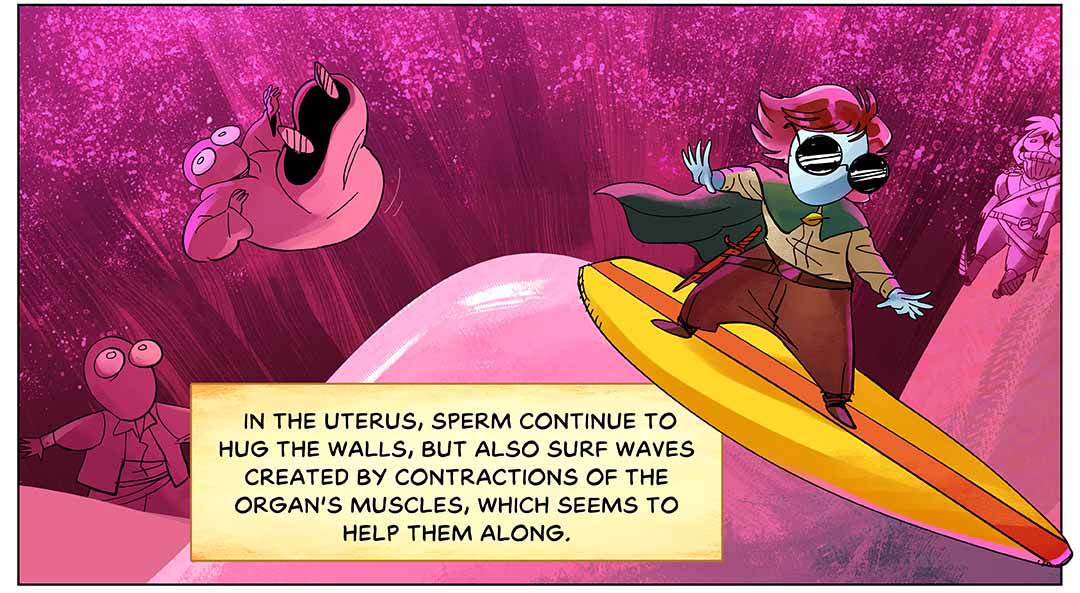
In the uterus, sperm continue to hug the walls, but also surf waves created by contractions of the organ’s muscles, which seems to help them along. Illustration: Sperm character, in sunglasses and cape, surfs through cervix, past other sperm.
The uterus is where they’re most likely to encounter the woman’s immune system. White blood cells, hungry for any foreign cell, arrive a couple of hours after the sperm do. Illustration: Large predatory creatures (representing white blood cells) chase and capture panicked sperm.
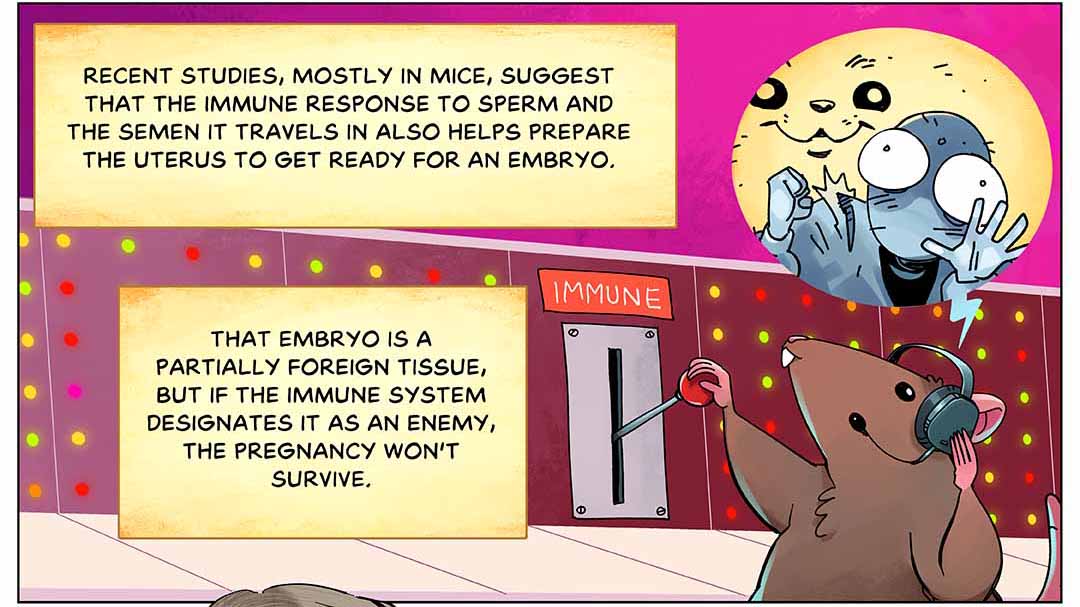
Recent studies, mostly in mice, suggest that the immune response to sperm and the semen it travels in also help prepare the uterus to get ready for an embryo. That embryo is a partially foreign tissue, but if the immune system designates it as an enemy, the pregnancy won’t survive. Illustration: A mouse wearing a headset pulls on a lever labeled “immune”, with an inset image of a sperm character peering through and banging against glass.
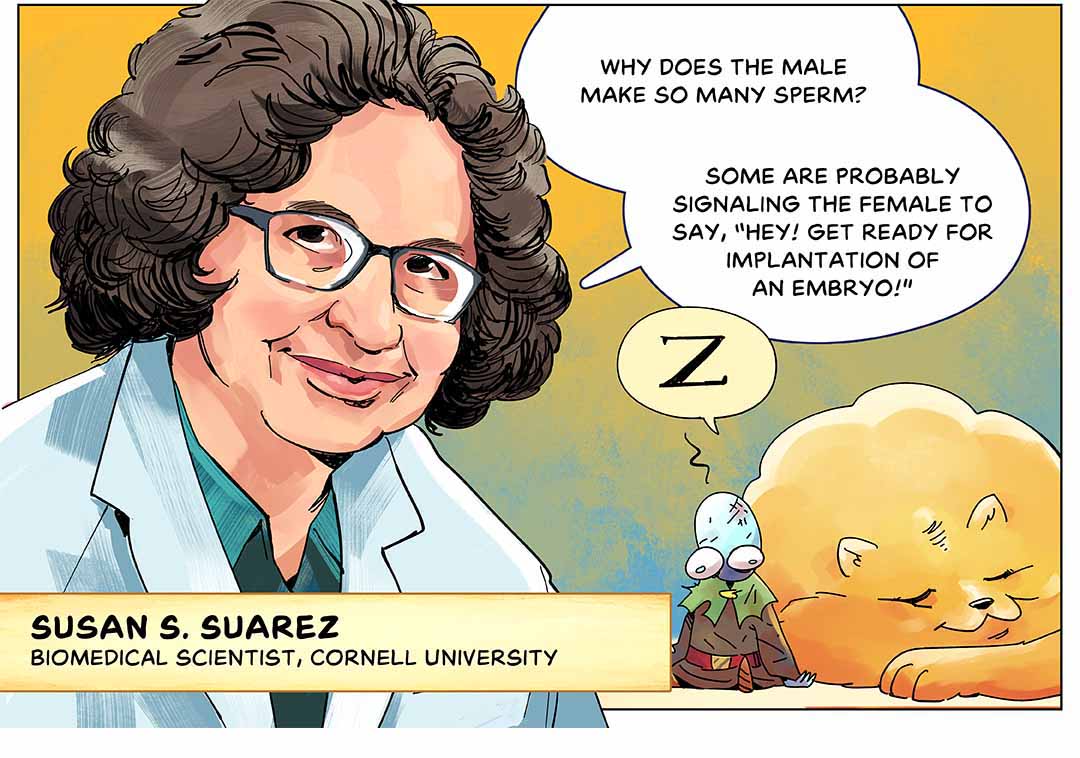
“Why does the male make so many sperm? Some are probably signaling the female to say, ‘Hey! Get ready for implantation of an embryo!’” says Susan S. Suarez, biomedical scientist, Cornell University. Illustration: A scientist in a white lab coat, wearing glasses, with a frazzled-looking sperm character sitting next to a sleeping white blood cell in the background.
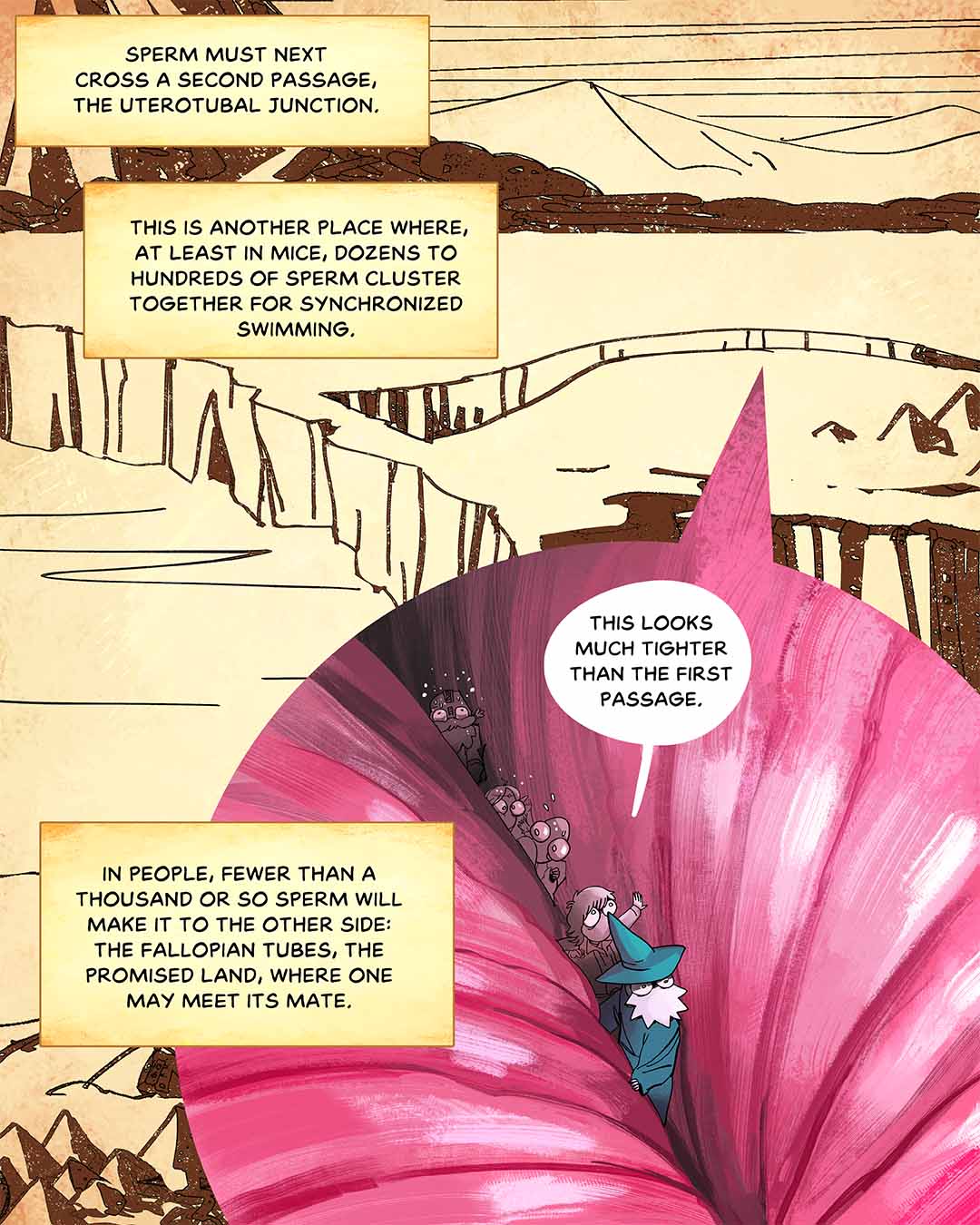
Sperm must next cross a second passage, the uterotubal junction. This is another place where, at least in mice, dozens to hundreds of sperm cluster together for synchronized swimming. In people, fewer than a thousand or so sperm will make it to the other side: the fallopian tubes, the promised land, where one may meet its mate. Illustration: Detail view of landscape map, with inset image showing sperm characters traversing a narrow passage. One has a speech bubble that says: “This looks much tighter than the first passage.”
If they’ve arrived before the egg is released, they can wait in the lower tubes. In this “reservoir,” they’ll stick to female cells lining the wall of the fallopian tubes, where the presence of sperm seems to stifle immune attack. In people, sperm can hang out for 3 to 5 days. Illustration: Sperm are in a waiting lounge, playing games, reading magazines, listening to music on a headset. On the wall are posters that read “Getting to the Egg” and “Hang in There!”
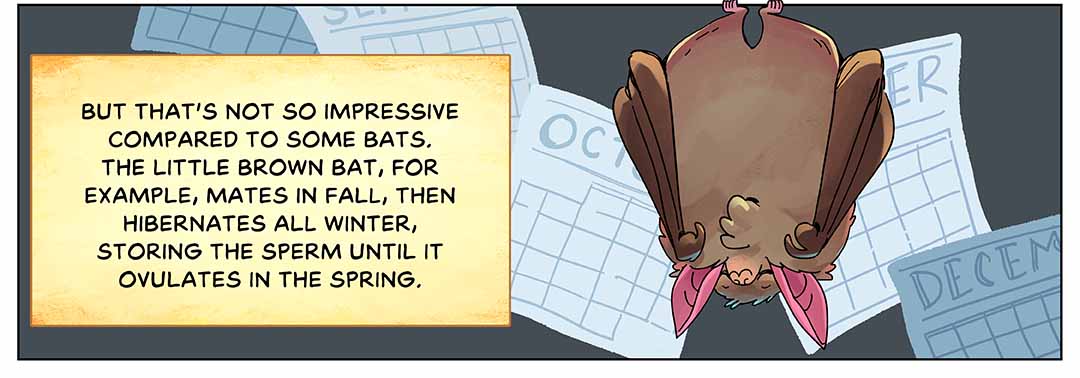
But that’s not so impressive compared to some bats. The little brown bat, for example, mates in fall, then hibernates all winter, storing the sperm until it ovulates in the spring. Illustration: A little brown bat sleeps upside-down. In the background are monthly calendar pages.
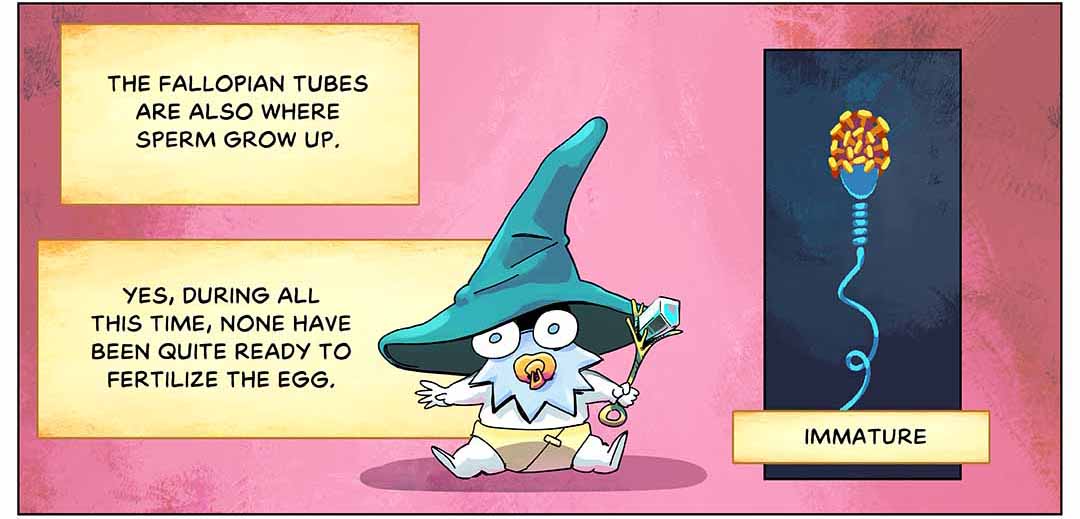
The fallopian tubes are also where sperm grow up. Yes, during all this time, none have been quite ready to fertilize the egg. Illustration: A baby sperm character sits on the ground, wearing a diaper, pointy wizard hat and holding a rattle that looks like a staff. Inset image shows sperm structure labeled “immature,” its head covered in a layer of molecules.
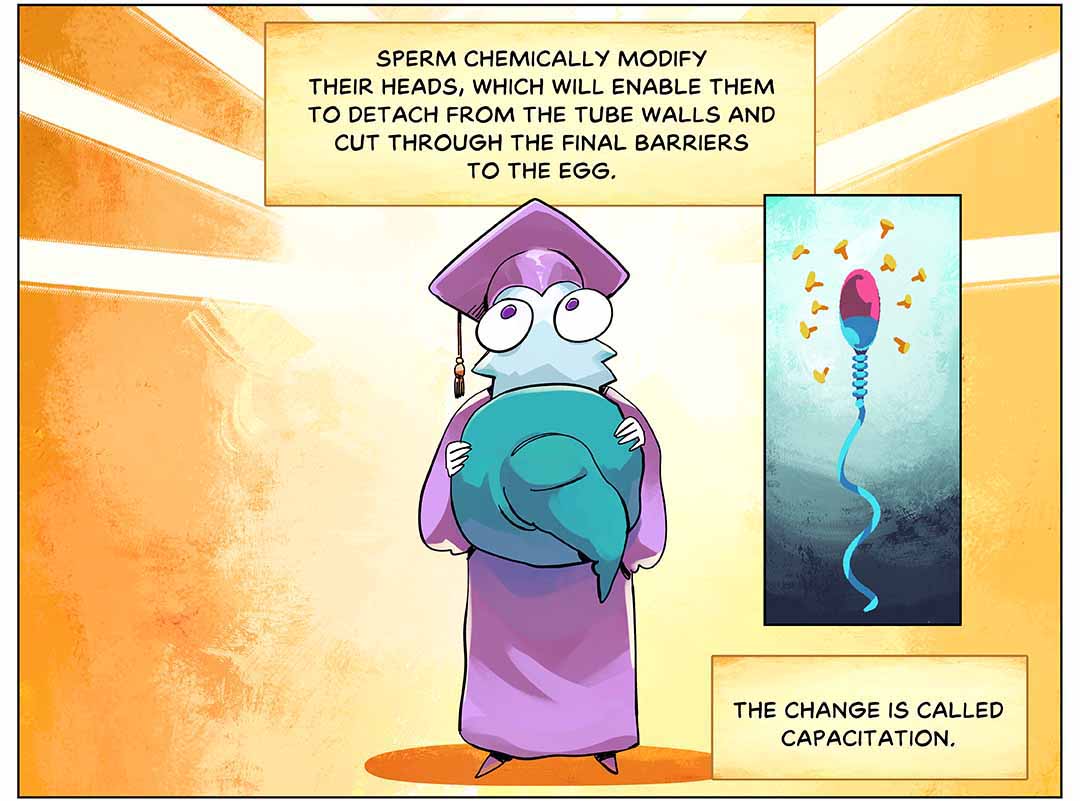
Sperm chemically modify their heads, which will enable them to detach from the tube walls and cut through the final barriers to the egg. The change is called capacitation. Illustration: Sperm character now grown up wearing a graduation gown and cap. Inset image of capacitated sperm structure shows a smooth, round head, shed of extra molecules.
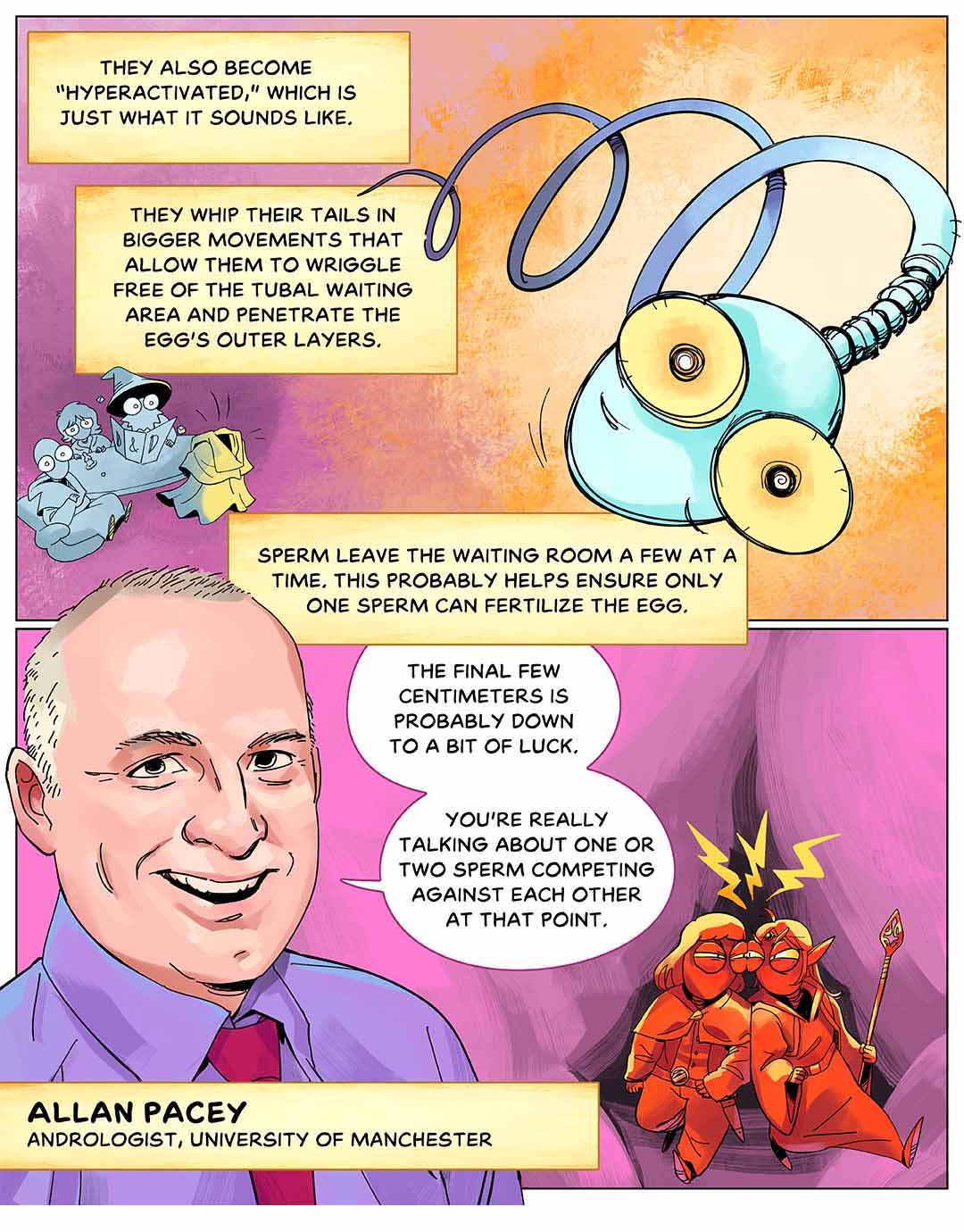
They also become “hyperactivated,” which is just what it sounds like. They whip their tails in bigger movements that allow them to wriggle free of the tubal waiting area and penetrate the egg’s outer layers. Sperm leave the waiting room a few at a time. This probably helps ensure only one sperm can fertilize the egg. Illustration: A sperm with a coiled tail whips around, looming over sperm characters sitting around a table. Below, portrait of scientist Allan Pacey (andrologist, University of Manchester) which a speech bubble that reads: “The final few centimeters is probably down to a bit of luck. You’re really talking about one or two sperm competing against each other at that point.” Behind him are two sperm characters racing each other through a narrow passage.
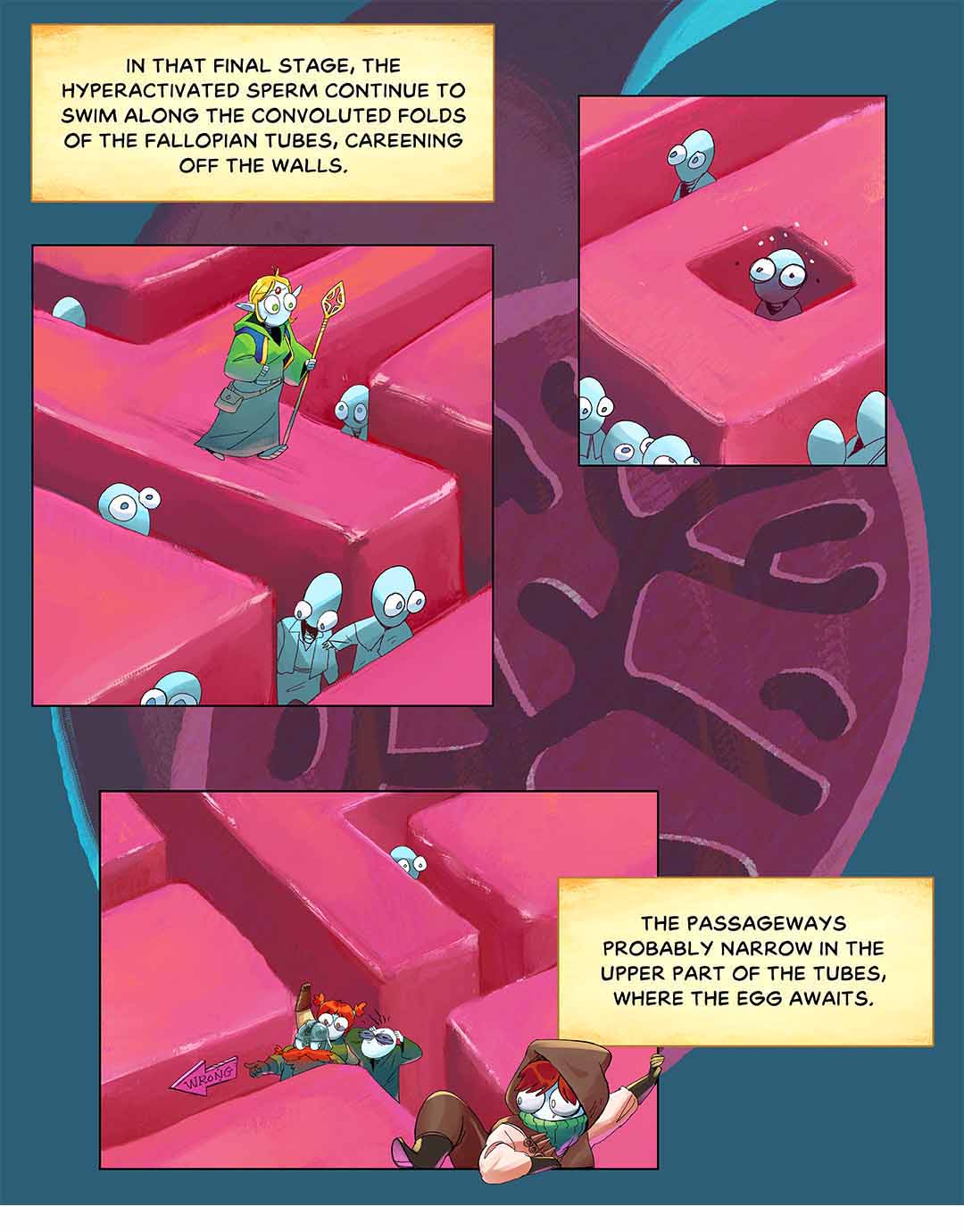
In that final stage, the hyperactivated sperm continue to swim along the convoluted folds of the fallopian tubes, careening off the walls. The passageways probably narrow in the upper part of the tubes, where the egg awaits. Illustration: Images of sperm characters squeezing through tight passages and folds that look like a maze. Some get lost; one crawls out.
Finally, they reach her, the egg. Illustration: Two sperm characters peer over the glowing edge of a cliff, with crystal-like structures in the background.
This is where the sperm must blow their lids, releasing enzymes that help them break through the surrounding cloud of cells and inner protein coat. Illustration: A cloud of sticky cells around the egg, with one sperm popping through.
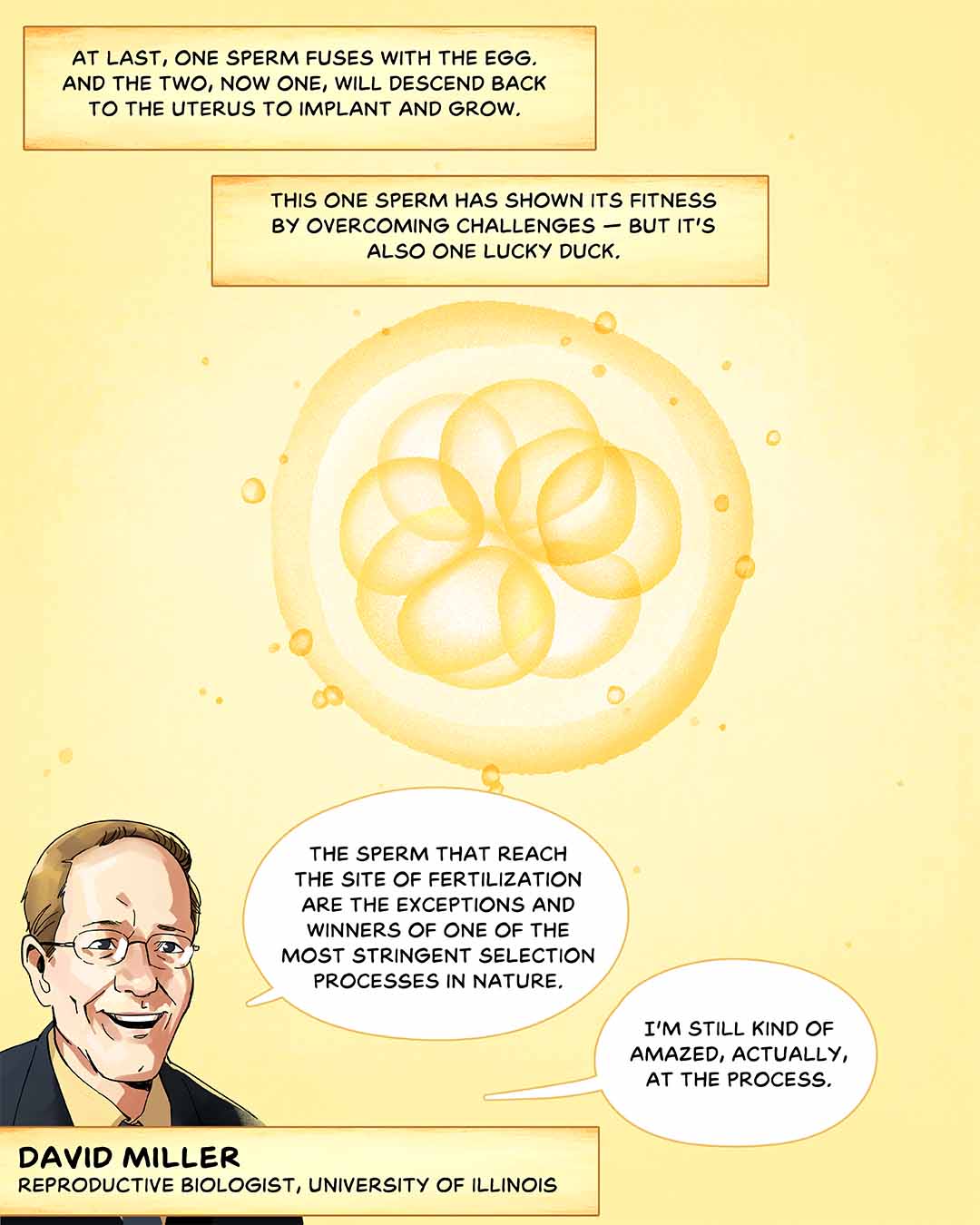
At last, one sperm fuses with the egg. And the two, now one, will descend back to the uterus to implant and grow. This one sperm has shown its fitness by overcoming challenges — but it’s also one lucky duck. Illustration: A developing zygote that has already divided a number of times to reach an 8-cell stage. Below, portrait of scientist David Miller, with speech bubbles saying, “The sperm that reach the site of fertilization are the exceptions and winners of one of the most stringent selection processes in nature. I’m still kind of amazed, actually, at the process.”