


LAYOUT MENU

Microbial Olympics: Super-duper one-celled athletes
They race, they leap, they spin, they shoot. Meet the organisms for whom physical prowess is more than sport — it’s a matter of life and death.
Support sound science and smart stories
Help us make scientific knowledge accessible to all
Donate today
In winter sports, lugers slide at more than 90 miles per hour, hockey players send the puck zipping across the ice at 100 mph, and figure skaters spin up to 342 rotations per minute. That’s fast.
But these human feats don’t seem so impressive when compared with the speed demons of the microbial world. In these ongoing games, minuscule predators and their prey hit high velocities during the chase. Hungry microbes make amazing leaps for food. Others hurl bits of their bodies or expand or contract with more force than astronauts experience at takeoff. Skier Lindsey Vonn has nothing on these speedsters.
Microbes accomplish these athletic feats even though they’re so small that their surroundings push back on them: A microbe paddling through water is like a skier trying to cut through a course neck-deep in honey. And they face life-or-death competitions in an unending evolutionary race. “The small world is not a very kind world,” says Manu Prakash, a bioengineer and oceanographer at Stanford University and coauthor of an article on ultrafast microbes in the 2025 Annual Review of Microbiology. “Either you are running away from something, or you are chasing something.”
Here, Knowable Magazine profiles speedy microbes that deserve their own medals.
Fastest bacteria
For pure speed, the reigning champ is an egg-shaped bacterium called Candidatus Ovobacter propellens (the name remains unofficial because scientists haven’t yet fully described it or grown it alone in a test tube). Discovered half a meter deep in the sands off Denmark’s coast, it uses its 400 tail-like flagella to swim at up to one millimeter per second.
But pitting all microbes against each other in a single race would be unfair. Some are big and some are small, which means they face different resistance from their surroundings. So in their review, the authors calculated speed in terms of body lengths per second.
For Candidatus O. propellens, a large-ish bacterium at four to five micrometers across, its top speed translates to about 200 body lengths per second. It is knocked off the winner’s podium by Magnetococcus marinus, a ball-shaped critter just a micrometer or two across that swims at up to 500 body lengths per second. Compare that to luge, deemed the fastest winter Olympic sport, where athletes zoom at about 25 body lengths per second.
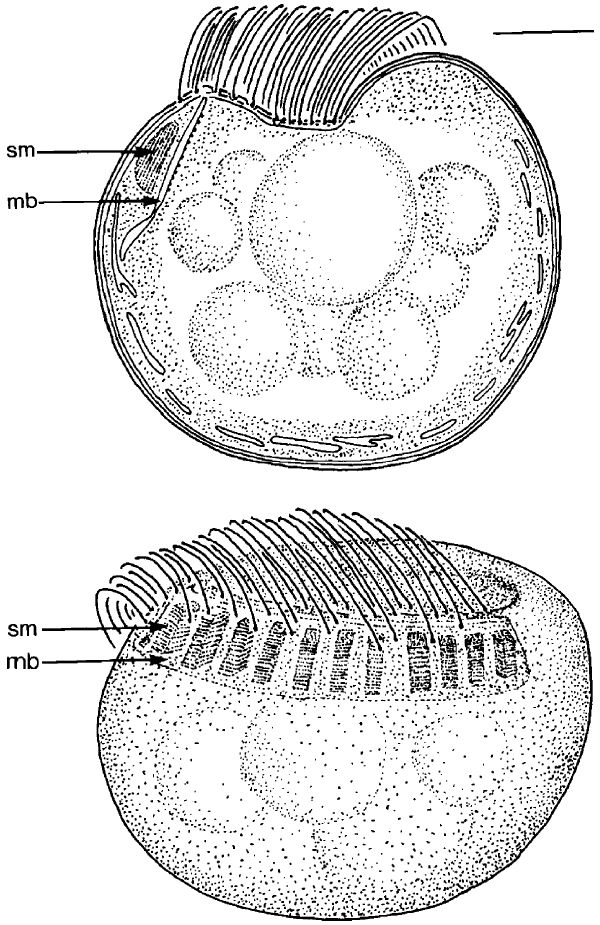
The microbe Candidatus Ovobacter propellens, seen here in cross-section (top) and side view (bottom), has a tuft of about 400 flagella that it uses to swim quickly. (It also possesses unusual membrane features of unknown purpose, including stacked membranes (sm) and a membrane band (mb).)
CREDIT: T. FENCHEL & R. THAR / FEMS MICROBIOLOGY ECOLOGY 2004
The particular M. marinus specimen that scientists clocked for speed was isolated from estuary waters in Rhode Island. When researchers first set up a new 3D microscope to observe this speedster, it tumbled so rapidly that they still had trouble assessing its path, recalls Damien Faivre, an interdisciplinary scientist at the University of Latvia in Riga.
After switching to a different microscope, Faivre and colleagues saw that M. marinus swam in a helical trajectory like a figure skater performing a multi-rotation axel. It moves using two rotating bundles of seven flagella each, one in front and one in back. Tracing that corkscrew motion was key to awarding M. marinus its record, says Faivre: When the scientists calculated the microbe’s speed based on that total distance, “it was actually traveling way more than expected.”
The microbe is called Magnetococcus because it possesses a string of magnetite crystals that acts like a little compass, helping it to navigate to the low-oxygen places it prefers. Someday, it might deliver medicines to the low-oxygen interiors of tumors. In one study, scientists stuck dozens of membranous satchels full of medicine all over the bacteria, injected them into mice, and used magnets to guide them close to tumors. From there, the microbes’ preferences for low oxygen drew more than half of them to penetrate the tumors.
Fastest archaea
Archaea are another domain of microbes, as distinct from bacteria as humans are, and were once thought to be slower swimmers.
Scientists disproved that notion in a 2012 analysis. Their top speedster, by body length, was Methanocaldococcus villosus, and it could give M. marinus a run for its money. A roundish microbe one to two micrometers across that loves hot places and spews methane, it clocked in at up to 468 body lengths per second.
M. villosus was discovered in a hydrothermal vent north of Iceland. It uses its more than 50 flagella not just to swim, but also to attach to surfaces like the walls of “black smokers,” chimneys around hydrothermal vents. Sometimes it uses those flagella to link with other M. villosus microbes.
This kind of speed generates heat. Take speed skater Erin Jackson, who won gold in Beijing in 2022 with a time of 37.04 seconds in the 500-meter. Propelling her five-foot-five-inch body some 500 body lengths per second would have gotten her to the finish line in about 0.6 seconds. But a human athlete, if they could accomplish that, would explode, says Prakash. Microorganisms can be fast because they are small. They have more surface area for their volume than larger critters, so they can release enough heat through exterior membranes.

Speedy squeezers
Figure skaters like Ilia Malinin tuck in their arms to spin faster, but the protozoan Spirostomum ambiguum performs a more extreme tuck. It can squish down to less than half the length of its wormlike one- to four-millimeter body in just five milliseconds.
But S. ambiguum isn’t leaping or spinning through the brackish waters it calls home. When it contracts, it squeezes out toxins to defend itself from predators. Prakash’s group reported that this superfast scrunch also generates a liquid vortex that tells neighboring cells something’s up. The wave, amplified as each microorganism squeezes in response, travels hundreds of times faster than the microbes can swim. Like ice hockey players working together, the microbial team synchronizes toxin-spewing.
As S. ambiguum scrunches, it feels acceleration of up to 15 g’s, on the low end of what a jet fighter pilot would experience upon ejecting from an aircraft. This force should destroy the cell’s innards; if Malinin shrank to even half his size, it’s safe to say he’d never perform another axel. Prakash’s team found that S. ambiguum is protected by a meshwork of its own interior membranes that serves as a shock absorber.
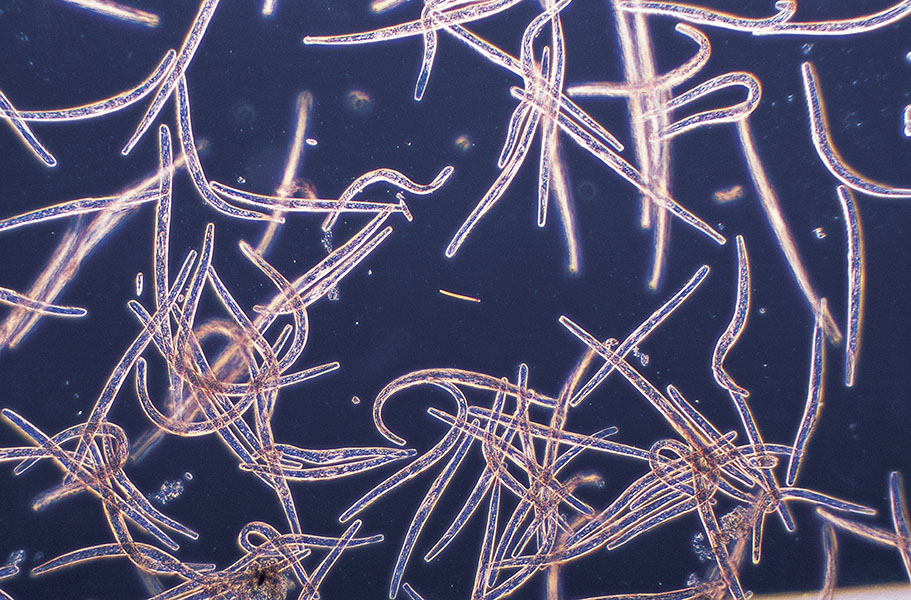
Spirostomum ambiguum, which can grow as long as 4 millimeters, can scrunch itself down to less than half its length — in a mere 5 milliseconds.
CREDIT: TIERBILD OKAPIA / SCIENCE SOURCE
Extreme expanders
If S. ambiguum does a big crunch, Pyrocystis noctiluca does the opposite: This glow-in-the-dark ocean plankton balloons to six times its starting size in under 10 minutes.
P. noctiluca lives an up-and-down life, transiting a vertical range of over 50 meters in the water column on a weekly round trip. Prakash, who described the rapid inflation in microbes collected off Hawaii, calls it the “world’s best marathon runner.”
At the top of its range, some 60 meters from the surface, P. noctiluca is about 200 to 700 micrometers across. There it uses photosynthesis to collect energy from sunlight. But it also needs nutrients more easily found deeper down. So it sinks, thanks to gravity, to a depth of about 150 meters, where it completes its cell cycle, dividing in two. But if those newborn cells drop too deep, they can’t overcome gravity and water pressure to rise. So they make what Prakash and colleagues describe as a “slingshot” maneuver. The microbes suck in fresh water, diminishing their density so that they rise like buoys.
Super shooters
Our final speedster is a parasite that impales host cells with a harpoon that it can shoot at upwards of 300 micrometers per second. Anncaliia algerae is a type of microsporidium, a group containing more than 1,700 species that collectively infect most kinds of animals and contaminate waterways and foodstuffs. More than a dozen of these species, including A. algerae, can infect humans, though it’s unclear how often this happens. The infection can be asymptomatic or mild, causing a variety of symptoms such as diarrhea. It can be fatal in people with weakened immune systems.
A. algerae floats along as a dormant, egg-shaped spore about four micrometers long, with its 100-micrometer-long harpoon, called the “polar tube,” coiled snugly within. Should that spore land in a suitable environment, such as someone’s small intestine, it shoots its shot. The harpoon’s speed might help it penetrate mucus coating the intestinal cells, speculates Gira Bhabha, a structural cell biologist at Johns Hopkins University in Baltimore.
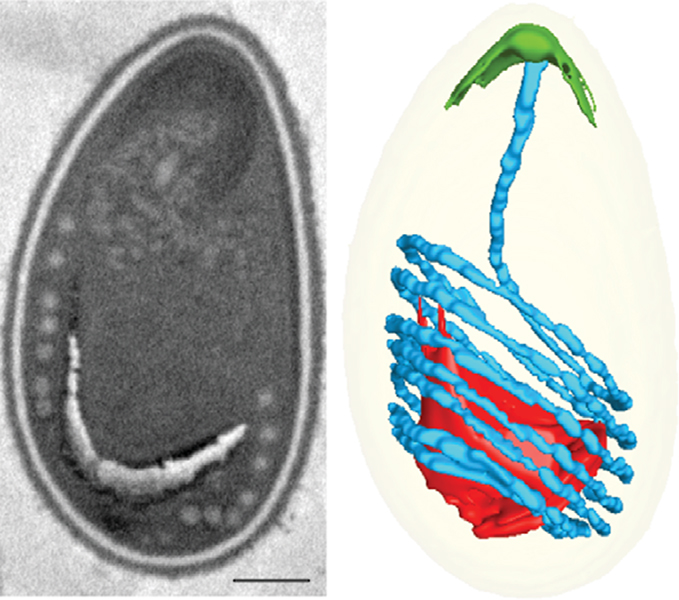
Spores of the parasite Anncaliia algerae (micrograph, left) possess a harpoon-like tube tightly coiled within (diagram, right). When the time is right, the spore unfurls the tube to penetrate a host.
CREDIT: R. CHANG ET AL / ELIFE 2024
Before the tube has even fully extended, the infectious material — at least two sets of fungal DNA, and perhaps the whole cell, Bhabha says — begins its journey through the tube. Though the tube is just 100 nanometers across, and the nuclei containing the DNA are seven times that, somehow they squeeze through, moving almost as fast as the tube unfurled itself.
Microsporidia were discovered more than 150 years ago, but scientists are still trying to work out how they manage these physical feats. Bhabha and Prakash suspect that the harpoon may evert as it emerges, like a sock being flipped inside-out.
Studying microbial Olympians is about more than busting records — it’s about defining the extremes that living things are capable of, says Prakash. These organisms exist in a completely different world from us, experiencing physical constraints and opportunities we don’t intuitively understand.
Plus, Prakash adds, figuring out that world could inspire novel inventions; he thinks S. ambiguum’s braking system could work at human scales, too.
“In the extreme,” he says, “always lies a gem.”
10.1146/knowable-012226-1
TAKE A DEEPER DIVE | Explore Related Scholarly Articles
More From